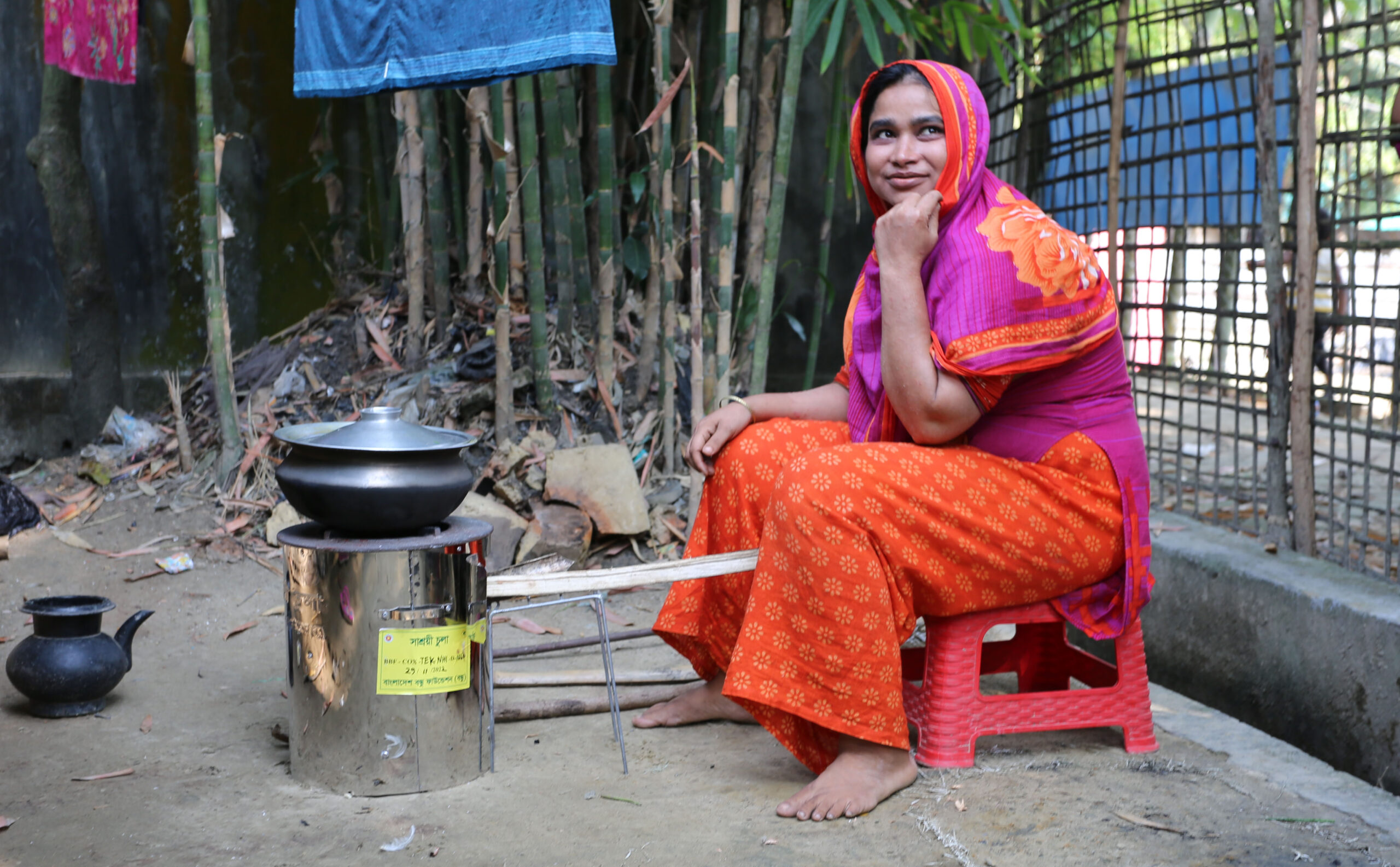
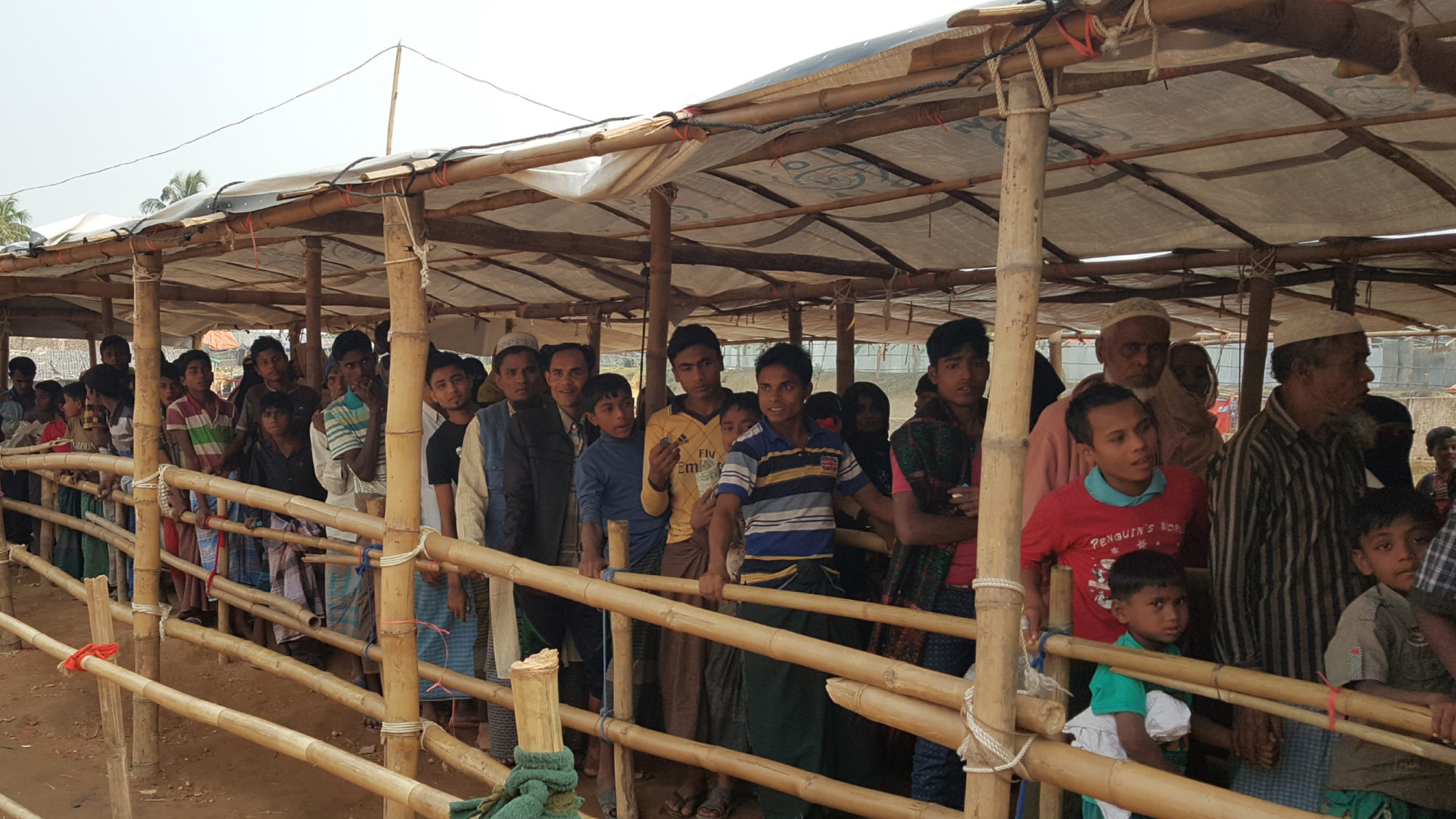
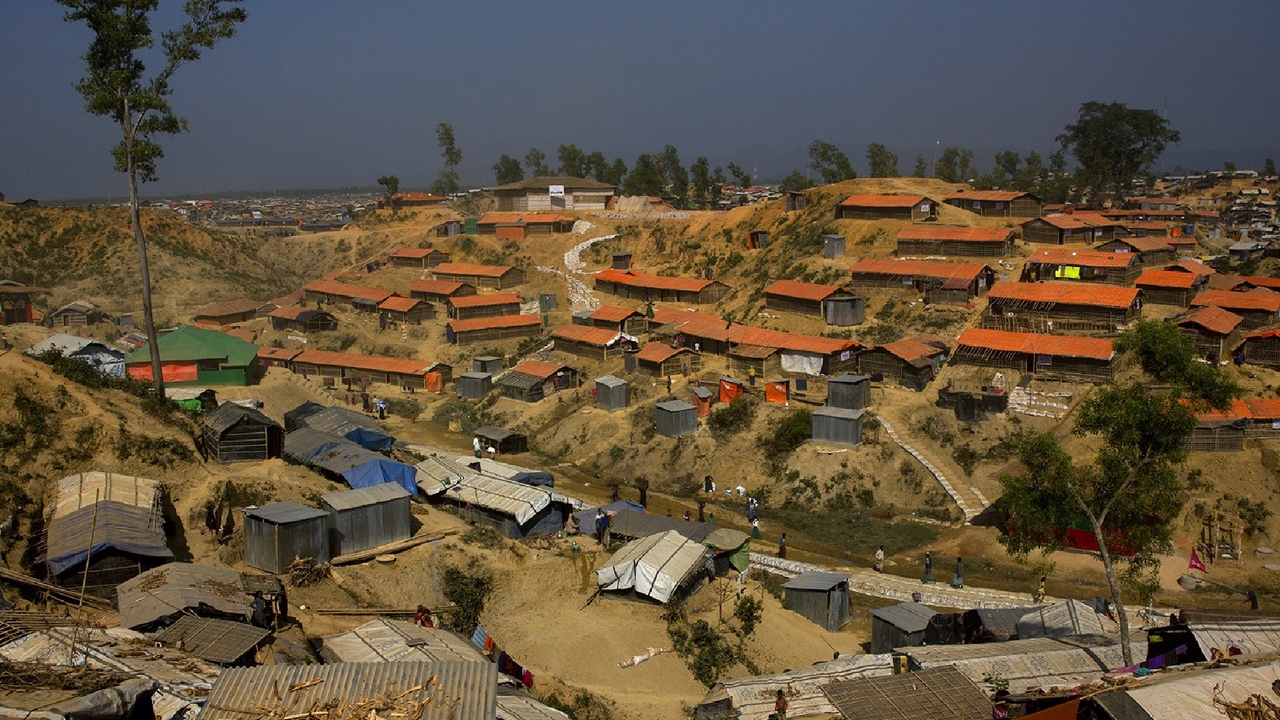
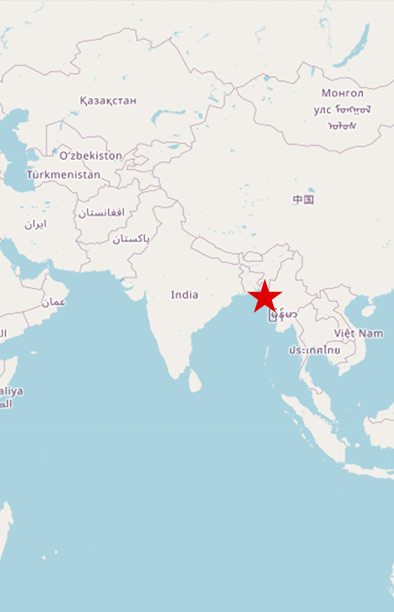
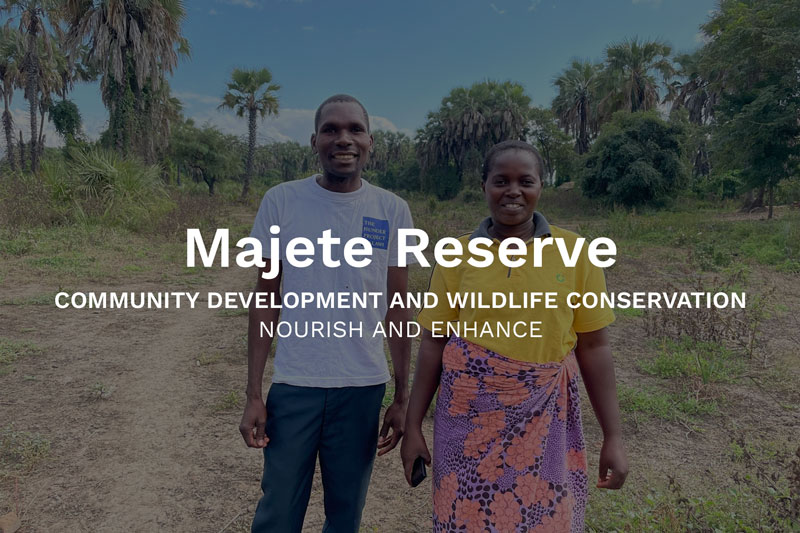
The project works with a large camp of Rohingya refugees in Bangladesh to replace firewood ovens with efficient cookstoves. Since firewood ovens pollute indoor air and destroy nearby forests, replacing them with efficient cookstoves improves air quality for the refugee community, and provides many additional ecological benefits to the surrounding environment.
The Cookstove Project provides a number of positive impacts for the refugee and the host community in Bangladesh. By lessening the amount of trees and brush cut down for firewood, the project preserves biodiversity. Reducing fumes and smoke in refugee homes improves reduces their risk of health complications associated with poor air quality and improves their quality of life, while boosting air quality as a whole in their communities an surrounding area.
Air
Reducing indoor smoke and the amount of firewood used results in cleaner air, both within homes and in the surrounding community.
Water
Switching to more efficient cookstoves reduces deforestation in the community, which improves the soil’s water-holding capacity and results in decreased erosion and runoff.
Soil
Shifting to more efficient cookstoves reduces deforestation in the community. Maintaining stable forests improves soil health and increases the soil’s ability to store carbon and other nutrients.
Biodiversity
Vegetative areas thrive when fewer trees and shrubs are used for cooking. These wooded areas also provide habitat for animals, insects, and diverse plant species in the surrounding area.
Equity
Efficient cookstoves reduce the burden on women to find wood for fuel. Among the project’s employees, 50% are local women, which fosters women’s empowerment and social interaction.
Carbon
The project encourages families to mitigate their carbon emissions by using more efficient, smokeless cookstoves. These cookstoves also reduce deforestation, which helps store carbon in the soil.
Land Tenure: (This cannot be discussed by request of the project as it is a contentious and possibly violent issue.)
Project Development
Project Developer: StarCB
The StarCB (SCB) company secures funding and develops carbon projects around the world. The Rohingya Refugee Cookstove Project works directly with local communities and is supported on the ground by SCB staff Shreya, Khaleq, and Sandeep. This local team ensures that on the ground facilities can provide vision and logistical support for the project.
Stakeholders & Beneficiaries
The Cookstove Project’s direct beneficiaries are refugees and their host communities. Beneficiaries desire better indoor air quality and more efficient fuelwood consumption in an area that suffers from large-scale deforestation. Numerous jobs are created for manufacturing and deploying the cookstoves. Indirect beneficiaries include those that provide ongoing maintenance and repair, as well as community engagement.
State of Development
Fully Operational
Project Launch
20220401
EBF Sector
Human
Project Type
Nourish and Enhance
Credit Type
Certificates
This project will undergo Gold Standard registration
Clean air is vital for maintaining human health, reducing the risk of respiratory diseases, and supporting ecosystem balance and biodiversity.
One of the primary objectives of the project is to encourage Rohingya refugees to switch to more efficient, smokeless cookstoves. This transition mitigates emissions, significantly improving indoor air quality and overall community health. It also decreases the amount of wood that is needed for fuel, which prevents deforestation and its associated detrimental impacts on air quality. The use of established metrics and periodic monitoring allows for a quantifiable improvement in indoor and outdoor air quality in areas where the cookstoves are used, which helps reduce chronic illnesses and health impacts stemming from traditional, less efficient cookstoves.
Practices
(to learn more about practices, check out our podcast series)
Air Quality (improved)
Air Quality (improved)
Practice
Positive modifications to air quality achieved by controlling and reducing pollution levels, dust, particulate matter (PM) emissions, and by consistently monitoring overall quality.
X
The project encourages switching to a more efficient smokeless cookstove that mitigates emissions and improves indoor air quality.
Ambient Air Monitoring
Ambient Air Monitoring
Practice
Long-term measurement and assessment of pollutant levels in outdoor air through monitoring stations and networks.
X
The project promotes efficient, smokeless cookstoves. It also assesses and monitors improvements to indoor and outdoor air quality using established metrics.
Appropriate Technology
Appropriate Technology
Practice
Use of machinery or equipment at appropriate size and scale in a manner that considers contextual factors (e.g., cultural preferences, ecosystem fragility, availability or affordability of technology, etc.).
X
Field officers collect data through a customized web-based app adapted to the project needs and technological capacities.
Carbon Sequestration
Carbon Sequestration
Practice
The capturing, removal, and storage of carbon dioxide (CO₂) from the earth's atmosphere; effectiveness typically expressed in terms of anticipated stability and duration of storage.
X
Using efficient cookstoves reduces the rate of deforestation in the region, allowing for increased carbon sequestration.
Deforestation (decreased)
Deforestation (decreased)
Practice
Halting or avoiding the removal of preexisting forest ecosystems; often requires combatting the conversion of forest ecosystems into land for commercial, industrial, or agricultural uses.
X
Using efficient cookstoves reduces the rate of deforestation in the region by reducing fuel wood consumption.
Forest Management (improved)
Forest Management (improved)
Practice
Management practices that focus on strengthening or restoring forest ecosystems to increase carbon stocks and reduce GHG emissions; may also focus on reducing GHG emissions and biodiversity loss from forestry disturbance.
X
Using efficient cookstoves reduces firewood consumption and subsequently decreases the rate of deforestation and biodiversity loss in the region.
Indoor Air Quality Monitoring
Indoor Air Quality Monitoring
Practice
Measurement and assessment of pollutants in indoor environments (e.g., residential, commercial, or industrial buildings).
X
The project promotes adoption of efficient, emissions-mitigating, and smokeless cookstoves, and it assesses indoor air quality improvements through periodic monitoring and baseline metrics.
CO₂ Emissions (reduced)
CO₂ Emissions (reduced)
Practice
Reducing carbon emissions and, in some cases, substituting the most carbon-intensive energy sources (e.g., coal, natural gas) with cleaner energy sources (e.g., hydroelectric, geothermal, biomass, solar, wind).
X
The project encourages switching to a more efficient, smokeless cookstove that mitigates carbon emissions. Use of the cookstoves also reduces deforestation and subsequent carbon losses.
Smart Sensors
Smart Sensors
Practice
Devices that use transducers to collect input data from the physical environment; data is then sent to network connection as a tool for carbon MRV.
X
The project uses simple and straightforward technologies to keep track of project data including cloud data storage and sensors in the cookstoves.
Water.
Clean and accessible water is crucial for the well-being of ecosystems, the preservation of biodiversity, and the fulfillment of essential human needs.
Reducing the need for fuel wood with more efficient cookstoves decreases deforestation. This ensures better water-holding capacity in the soil and restores local water cycles. As a result, the project not only improves the health of refugees, it also has a positive impact on soil fertility and the overall ecosystem, contributing to water conservation efforts.
Practices
(to learn more about practices, check out our podcast series)
Deforestation (decreased)
Deforestation (decreased)
Practice
Halting or avoiding the removal of preexisting forest ecosystems; often requires combatting the conversion of forest ecosystems into land for commercial, industrial, or agricultural uses.
X
Using efficient cookstoves reduces the rate of deforestation in the region by reducing fuel wood consumption.
Forest Management (improved)
Forest Management (improved)
Practice
Management practices that focus on strengthening or restoring forest ecosystems to increase carbon stocks and reduce GHG emissions; may also focus on reducing GHG emissions and biodiversity loss from forestry disturbance.
X
Using efficient cookstoves reduces firewood consumption and subsequently decreases the rate of deforestation and biodiversity loss in the region.
Water Conservation (increased)
Water Conservation (increased)
Practice
Use of sustainable water management practices to reduce consumption of water resources and to use water resources more efficiently; in agriculture, examples may include improved irrigation schedules and crop-specific irrigation techniques.
X
Using efficient cookstoves reduces the rate of deforestation in the region and subsequently ensures better water-holding capacity for soil and in local evapotranspiration cycles.
CO₂ Emissions (reduced)
CO₂ Emissions (reduced)
Practice
Reducing carbon emissions and, in some cases, substituting the most carbon-intensive energy sources (e.g., coal, natural gas) with cleaner energy sources (e.g., hydroelectric, geothermal, biomass, solar, wind).
X
The project encourages switching to a more efficient, smokeless cookstove that mitigates carbon emissions. Use of the cookstoves also reduces deforestation and subsequent carbon losses.
Smart Sensors
Smart Sensors
Practice
Devices that use transducers to collect input data from the physical environment; data is then sent to network connection as a tool for carbon MRV.
X
The project uses simple and straightforward technologies to keep track of project data including cloud data storage and sensors in the cookstoves.
Soil.
Healthy soils are essential for promoting robust plant growth, enhancing nutrient cycling, supporting diverse microbial communities, and mitigating soil erosion.
Efficient cookstoves deployed as part of the Rohingya Refugee Cookstove Project play a pivotal role in promoting soil health. By reducing deforestation in the region, the project helps maintain the integrity of the local ecosystem. This, in turn, contributes to increased carbon sequestration, which enhances water-holding capacity in the soil. As the rate of deforestation decreases due to reduced demand for firewood, the soil is less prone to erosion and degradation. This sustainable approach not only mitigates deforestation issues but also fosters better soil fertility and overall ecosystem health.
Practices
(to learn more about practices, check out our podcast series)
Carbon Sequestration
Carbon Sequestration
Practice
The capturing, removal, and storage of carbon dioxide (CO₂) from the earth's atmosphere; effectiveness typically expressed in terms of anticipated stability and duration of storage.
X
Using efficient cookstoves reduces the rate of deforestation in the region, allowing for increased carbon sequestration.
Carbon Sink
Carbon Sink
Practice
A natural or artificial reservoir that absorbs and stores carbon dioxide (CO₂) from the atmosphere; helps mitigate climate change by reducing the concentration of GHGs; systems that absorb more carbon than they release (e.g., forests, oceans, soils) play a crucial role in balancing the carbon cycle.
X
The project helps mitigate deforestation issues to ensure that carbon is sequestered and stable within surrounding forest ecosystems serving as carbon sinks.
Deforestation (decreased)
Deforestation (decreased)
Practice
Halting or avoiding the removal of preexisting forest ecosystems; often requires combatting the conversion of forest ecosystems into land for commercial, industrial, or agricultural uses.
X
Using efficient cookstoves reduces the rate of deforestation in the region by reducing fuel wood consumption.
Forest Management (improved)
Forest Management (improved)
Practice
Management practices that focus on strengthening or restoring forest ecosystems to increase carbon stocks and reduce GHG emissions; may also focus on reducing GHG emissions and biodiversity loss from forestry disturbance.
X
Using efficient cookstoves reduces firewood consumption and subsequently decreases the rate of deforestation and biodiversity loss in the region.
Water Conservation
Water Conservation
Practice
Use of sustainable water management practices to reduce consumption of water resources and to use water resources more efficiently; in agriculture, examples may include improved irrigation schedules and crop-specific irrigation techniques.
X
Using efficient cookstoves reduces the rate of deforestation in the region and subsequently ensures better water-holding capacity for soil and in local evapotranspiration cycles.
CO₂ Emissions (reduced)
CO₂ Emissions (reduced)
Practice
Reducing carbon emissions and, in some cases, substituting the most carbon-intensive energy sources (e.g., coal, natural gas) with cleaner energy sources (e.g., hydroelectric, geothermal, biomass, solar, wind).
X
The project encourages switching to a more efficient, smokeless cookstove that mitigates carbon emissions. Use of the cookstoves also reduces deforestation and subsequent carbon losses.
Smart Sensors
Smart Sensors
Practice
Devices that use transducers to collect input data from the physical environment; data is then sent to network connection as a tool for carbon MRV.
X
The project uses simple and straightforward technologies to keep track of project data including cloud data storage and sensors in the cookstoves.
Soil Fertility (improved)
Soil Fertility (improved)
Practice
The ability of soil to support plant growth for agriculture purposes or as suitable habitat for native plants; in agriculture, assesses the soil's ability to provide sustained and consistent yields of high quality crops.
X
Using efficient cookstoves reduces the rate of deforestation in the region, which leads to reduced disturbance of soil ecosystems and fertility.
Biodiversity.
Clean and accessible water is crucial for the well-being of ecosystems, the preservation of biodiversity, and the fulfillment of essential human needs.
The promotion of efficient cookstoves for the Rohingya Refugee Cookstove Project not only helps reduce deforestation, it also plays a vital role in biodiversity preservation. By reducing the pressure for firewood consumption, the project effectively curbs the rate of deforestation and, in turn, contributes to the preservation of local biodiversity. This conservation effort is particularly significant for the region, as it allows native flora and fauna to thrive with minimal habitat disruption. By mitigating deforestation issues, the project ensures that the delicate balance of the local ecosystem is restored and maintained, providing a conducive environment for the coexistence of diverse plant and animal species.
Practices
(to learn more about practices, check out our podcast series)
Air Quality (improved)
Air Quality (improved)
Practice
Positive modifications to air quality achieved by controlling and reducing pollution levels, dust, particulate matter (PM) emissions, and by consistently monitoring overall quality.
X
The project encourages switching to a more efficient smokeless cookstove that mitigates emissions and improves indoor air quality.
Carbon Sequestration
Carbon Sequestration
Practice
The capturing, removal, and storage of carbon dioxide (CO₂) from the earth's atmosphere; effectiveness typically expressed in terms of anticipated stability and duration of storage.
X
Using efficient cookstoves reduces the rate of deforestation in the region, allowing for increased carbon sequestration.
Carbon Sink
Carbon Sink
Practice
A natural or artificial reservoir that absorbs and stores carbon dioxide (CO₂) from the atmosphere; helps mitigate climate change by reducing the concentration of GHGs; systems that absorb more carbon than they release (e.g., forests, oceans, soils) play a crucial role in balancing the carbon cycle.
X
The project helps mitigate deforestation issues to ensure that carbon is sequestered and stable within surrounding forest ecosystems serving as carbon sinks.
Deforestation (decreased)
Deforestation (decreased)
Practice
Halting or avoiding the removal of preexisting forest ecosystems; often requires combatting the conversion of forest ecosystems into land for commercial, industrial, or agricultural uses.
X
Using efficient cookstoves reduces the rate of deforestation in the region by reducing fuel wood consumption.
Forest Management (improved)
Forest Management (improved)
Practice
Management practices that focus on strengthening or restoring forest ecosystems to increase carbon stocks and reduce GHG emissions; may also focus on reducing GHG emissions and biodiversity loss from forestry disturbance.
X
Using efficient cookstoves reduces firewood consumption and subsequently decreases the rate of deforestation and biodiversity loss in the region.
Water Conservation (increased)
Water Conservation (increased)
Practice
Use of sustainable water management practices to reduce consumption of water resources and to use water resources more efficiently; in agriculture, examples may include improved irrigation schedules and crop-specific irrigation techniques.
X
Using efficient cookstoves reduces the rate of deforestation in the region and subsequently ensures better water-holding capacity for soil and in local evapotranspiration cycles.
CO₂ Emissions (reduced)
CO₂ Emissions (reduced)
Practice
Reducing carbon emissions and, in some cases, substituting the most carbon-intensive energy sources (e.g., coal, natural gas) with cleaner energy sources (e.g., hydroelectric, geothermal, biomass, solar, wind).
X
The project encourages switching to a more efficient, smokeless cookstove that mitigates carbon emissions. Use of the cookstoves also reduces deforestation and subsequent carbon losses.
Smart Sensors
Smart Sensors
Practice
Devices that use transducers to collect input data from the physical environment; data is then sent to network connection as a tool for carbon MRV.
X
The project uses simple and straightforward technologies to keep track of project data including cloud data storage and sensors in the cookstoves.
Soil Fertility (improved)
Soil Fertility (improved)
Practice
The ability of soil to support plant growth for agriculture purposes or as suitable habitat for native plants; in agriculture, assesses the soil's ability to provide sustained and consistent yields of high quality crops.
X
Using efficient cookstoves reduces the rate of deforestation in the region, which leads to reduced disturbance of soil ecosystems and fertility.
Equity.
Supporting equity and inclusion fosters social justice, ensures equal access to resources derived from the environment, and promotes the well-being and participation of all, regardless of background or circumstances.
The Rohingya Refugee Cookstove Project goes beyond its environmental goals and places a strong emphasis on social equity. Notably, the project demonstrates a commitment to gender equality, with women comprising 50% of the personnel employed by the initiative. This aspect not only underscores the importance of women's inclusion and empowerment, it also sets a powerful example for the community.
Women's groups formed as part of the project serve as a vehicle for social interaction and empowerment. Through these groups, women are encouraged to take an active role in the project's activities and decision-making processes, fostering a sense of belonging and empowerment among the Rohingya refugees.
Practices
(to learn more about practices, check out our podcast series)
Affordability
Affordability
Practice
The extent to which a person or household has the financial capacity to purchase or access a product, service, or basic necessity without facing undue financial burden. Often measured relative to the local economy in a given place.
X
The project dispenses cookstove materials, support, and information free of charge to the Rohingya Refugee population in order to ensure efficient stoves are accessible and affordable for all.
Ambient Air Monitoring
Ambient Air Monitoring
Practice
Long-term measurement and assessment of pollutant levels in outdoor air through monitoring stations and networks.
X
The project promotes efficient, smokeless cookstoves. It also assesses and monitors improvements to indoor and outdoor air quality using established metrics.
Gender Equity
Gender Equity
Practice
The provision of fairness and justice in the distribution of benefits and responsibilities between women and men.
X
Women comprise 50% of the personnel employed by the project, and women's groups are formed to encourage social interaction and empowerment that might not have occurred otherwise.
Job Security (increased)
Job Security (increased)
Practice
Assurance that an employee can continue working their current job for the foreseeable future.
X
The project uses manufacturing facilities to produce the cookstoves, and it uses a network of sub-offices and local administrations to manage operations and distribution systems.
Indoor Air Quality Monitoring
Indoor Air Quality Monitoring
Practice
Measurement and assessment of pollutants in indoor environments (e.g., residential, commercial, or industrial buildings).
X
The project promotes adoption of efficient, emissions-mitigating, and smokeless cookstoves, and it assesses indoor air quality improvements through periodic monitoring and baseline metrics.
Local Engagement and Regional Collaboration
Local Engagement and Regional Collaboration
Practice
Fostering connections and collaborations between producers, processors, distributors, and retailers to maximize positive social, economic, and ecological impacts within communities and across regions.
X
The project employs the community to administer monthly visits and verifications. They provide the data, which is reviewed for accuracy, verified, and then put into the carbon count.
Periodic Audits
Periodic Audits
Practice
Intermittent inspections of a project or intervention to assess and verify that anticipated impact (e.g., carbon stocks, emissions reductions) and permanence are occurring as intended.
X
Data related to the number of cookstoves deployed is updated on a daily basis, and random checks occur on a monthly basis after the installations are verified.
Socioeconomic Data Collection
Socioeconomic Data Collection
Practice
Gathering data on socioeconomic factors (e.g., income, education, employment, access to services) to understand disparities and identify areas that require targeted interventions.
X
Field officers collect background information, cookstove information, the status of cookstoves, and the needs and status of houses from clients using a web-based app.
Women's Economic Empowerment
Women's Economic Empowerment
Practice
The increased capacity of women to participate in, contribute to, and benefit from economic resources and opportunities (e.g., jobs, financial services, property, skills development); increases ability to negotiate fairer distribution of benefits derived from economic growth.
X
Switching to more efficient cookstoves reduces the burden on women to collect fuelwood and also reduces health impacts that stem from cooking with less efficient stoves.
Carbon.
Carbon capture and storage plays a crucial role in tackling climate change, and by safeguarding the sustainability of our ecosystems, helps to ensure a thriving future for all living beings.
Using efficient cookstoves significantly reduces the emissions produced by wood burning stoves and, by reducing fuel wood consumption, decreases the rate of deforestation in the region. This, in turn, leads to increased carbon sequestration.
The project receives carbon credits issued by the Gold Standard and sells these credits to companies and brokers on the voluntary and compliance credit markets. By doing so, the project helps mitigate deforestation issues while contributing to global carbon emissions offsetting efforts.
Practices
(to learn more about practices, check out our podcast series)
Air Quality (improved)
Air Quality (improved)
Practice
Positive modifications to air quality achieved by controlling and reducing pollution levels, dust, particulate matter (PM) emissions, and by consistently monitoring overall quality.
X
The project encourages switching to a more efficient smokeless cookstove that mitigates emissions and improves indoor air quality.
Appropriate Technology
Appropriate Technology
Practice
Use of machinery or equipment at appropriate size and scale in a manner that considers contextual factors (e.g., cultural preferences, ecosystem fragility, availability or affordability of technology, etc.).
X
Field officers collect data through a customized web-based app adapted to the project needs and technological capacities.
Carbon Sequestration
Carbon Sequestration
Practice
The capturing, removal, and storage of carbon dioxide (CO₂) from the earth's atmosphere; effectiveness typically expressed in terms of anticipated stability and duration of storage.
X
Using efficient cookstoves reduces the rate of deforestation in the region, allowing for increased carbon sequestration.
Carbon Sink
Carbon Sink
Practice
A natural or artificial reservoir that absorbs and stores carbon dioxide (CO₂) from the atmosphere; helps mitigate climate change by reducing the concentration of GHGs; systems that absorb more carbon than they release (e.g., forests, oceans, soils) play a crucial role in balancing the carbon cycle.
X
The project helps mitigate deforestation issues to ensure that carbon is sequestered and stable within surrounding forest ecosystems serving as carbon sinks.
Deforestation (decreased)
Deforestation (decreased)
Practice
Halting or avoiding the removal of preexisting forest ecosystems; often requires combatting the conversion of forest ecosystems into land for commercial, industrial, or agricultural uses.
X
Using efficient cookstoves reduces the rate of deforestation in the region by reducing fuel wood consumption.
Forest Management (improved)
Forest Management (improved)
Practice
Management practices that focus on strengthening or restoring forest ecosystems to increase carbon stocks and reduce GHG emissions; may also focus on reducing GHG emissions and biodiversity loss from forestry disturbance.
X
Using efficient cookstoves reduces firewood consumption and subsequently decreases the rate of deforestation and biodiversity loss in the region.
CO₂ Emissions (reduced)
CO₂ Emissions (reduced)
Practice
Reducing carbon emissions and, in some cases, substituting the most carbon-intensive energy sources (e.g., coal, natural gas) with cleaner energy sources (e.g., hydroelectric, geothermal, biomass, solar, wind).
X
The project encourages switching to a more efficient, smokeless cookstove that mitigates carbon emissions. Use of the cookstoves also reduces deforestation and subsequent carbon losses.
Smart Sensors
Smart Sensors
Practice
Devices that use transducers to collect input data from the physical environment; data is then sent to network connection as a tool for carbon MRV.
X
The project uses simple and straightforward technologies to keep track of project data including cloud data storage and sensors in the cookstoves.
Socioeconomic Data Collection
Socioeconomic Data Collection
Practice
Gathering data on socioeconomic factors (e.g., income, education, employment, access to services) to understand disparities and identify areas that require targeted interventions.
X
Field officers collect background information, cookstove information, the status of cookstoves, and the needs and status of houses from clients using a web-based app.
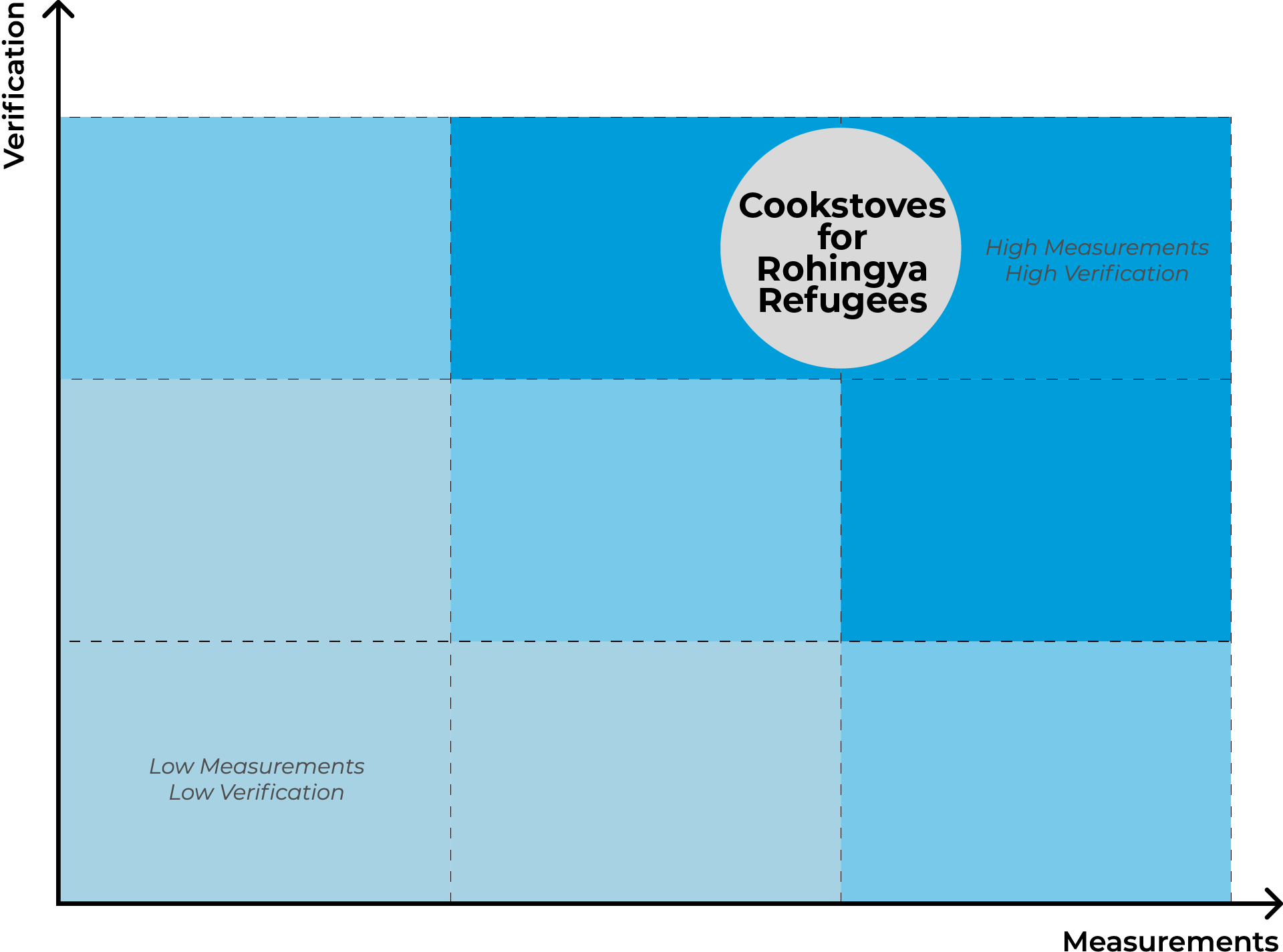
Measurement, Reporting and Verification (MRV)
The Rohingya Refugee Cookstove Project uses a meticulous approach to monitor, report, and verify its impacts. It uses established metrics and periodic monitoring to assess changes in air quality, emissions reductions, and the amount of wood used for fuel. Field officers collect data through a web-based app to ensure accurate and comprehensive collection of data.
The project also follows stringent regulatory and voluntary guidelines, adhering to Gold Standard Emission Reductions methodologies to demonstrate additional carbon reductions. Its cloud-based infrastructure allows for real-time storage and verification of data, with monthly household data validation visits, and it comprehensively measures its environmental and social impacts to maintain complete data transparency.
[Learn more about the challenges of measurement and equity]
Primary Measurement Methods
This overview is not an endorsement or recommendation and should not be used as the basis for any investment decision.
Measurement (M)
Description
Benefits
Reporting Method (R)
Verification Type (V)
Emissions Monitoring
The project quantifies emission reductions as a function of the reduction in the amount of non-renewable biomass fuel consumption in the efficient project stoves as compared to baseline stoves, calculated by applying specialized equations.
Clean air is vital for maintaining human health, reducing the risk of respiratory diseases, and supporting ecosystem balance and biodiversity.
Air.
Air.
Clean and accessible water is crucial for the well-being of ecosystems, the preservation of biodiversity, and the fulfillment of essential human needs.
Water.
Water.
Healthy soils are essential for promoting robust plant growth, enhancing nutrient cycling, supporting diverse microbial communities, and mitigating soil erosion.
Soil.
Soil.
Enhancing and safeguarding biodiversity ensures the stability of ecosystems by providing invaluable services such as pollination, pest control, and genetic diversity.
Biodiversity.
Biodiversity.
Diversity and inclusion foster social justice, ensure equal access to resources derived from the environment, and promote the well-being of all, regardless of background.
Equity.
Equity.
Carbon capture and storage is crucial for tackling climate change, and by safeguarding the sustainability of our ecosystems, helps to ensure a thriving future for all.
Carbon.
Carbon.
Measuring, assessment, and record-keeping conducted by the project collaborators. Self-reporting may include fieldwork, collecting quantitative and qualitative data, stakeholder evaluations, verifying paperwork, and other methods.
Self-Reported
Self-Reported
Project collaborators may use data capture and verification methods such as game cameras, in-field geo-referenced documentation, and satellite data to confirm self-reported results.
Raw Data
Raw Data
Some or all data is placed onto blockchain to ensure the immutability and transparency of specified shared data, sometimes using specified protocols for designated certifiers and registries.
On-Blockchain
On-Blockchain
Evaluation or assessment conducted by an independent, trusted entity utilizing established standards and protocols, often in association with a specified certification process.
Standards & Certifications
Standards & Certifications
Evaluation or assessment is conducted by an independent, trusted entity to ensure the accuracy and integrity of reported data.
Third-Party Verified
Third-Party Verified
Record keeping mechanism that establishes standardized protocols for credit issuance and project registration, and provides a public ledger where credit ownership can be tracked from creation to retirement; the traceability of registry transactions protects the integrity of credit assets by ensuring that a credit or token cannot be allocated to more than one entity.
Registry
Registry
Ambient Air Monitoring
The project encourages switching to a more efficient smokeless cookstove based on established metrics and utilizes periodic monitoring for comparing indoor and outdoor air quality improvements in locations where the cookstoves are used.
Clean air is vital for maintaining human health, reducing the risk of respiratory diseases, and supporting ecosystem balance and biodiversity.
Air.
Air.
Clean and accessible water is crucial for the well-being of ecosystems, the preservation of biodiversity, and the fulfillment of essential human needs.
Water.
Water.
Healthy soils are essential for promoting robust plant growth, enhancing nutrient cycling, supporting diverse microbial communities, and mitigating soil erosion.
Soil.
Soil.
Enhancing and safeguarding biodiversity ensures the stability of ecosystems by providing invaluable services such as pollination, pest control, and genetic diversity.
Biodiversity.
Biodiversity.
Diversity and inclusion foster social justice, ensure equal access to resources derived from the environment, and promote the well-being of all, regardless of background.
Equity.
Equity.
Carbon capture and storage is crucial for tackling climate change, and by safeguarding the sustainability of our ecosystems, helps to ensure a thriving future for all.
Carbon.
Carbon.
Measuring, assessment, and record-keeping conducted by the project collaborators. Self-reporting may include fieldwork, collecting quantitative and qualitative data, stakeholder evaluations, verifying paperwork, and other methods.
Self-Reported
Self-Reported
Project collaborators may use data capture and verification methods such as game cameras, in-field geo-referenced documentation, and satellite data to confirm self-reported results.
Raw Data
Raw Data
Some or all data is placed onto blockchain to ensure the immutability and transparency of specified shared data, sometimes using specified protocols for designated certifiers and registries.
On-Blockchain
On-Blockchain
Evaluation or assessment conducted by an independent, trusted entity utilizing established standards and protocols, often in association with a specified certification process.
Standards & Certifications
Standards & Certifications
Evaluation or assessment is conducted by an independent, trusted entity to ensure the accuracy and integrity of reported data.
Third-Party Verified
Third-Party Verified
Record keeping mechanism that establishes standardized protocols for credit issuance and project registration, and provides a public ledger where credit ownership can be tracked from creation to retirement; the traceability of registry transactions protects the integrity of credit assets by ensuring that a credit or token cannot be allocated to more than one entity.
Registry
Registry
Socioeconomic Data Collection
Field officers collect background information on the refugees and
cookstoves, including the status of the cookstoves and the household needs of clients, using a web-based app.
Clean air is vital for maintaining human health, reducing the risk of respiratory diseases, and supporting ecosystem balance and biodiversity.
Air.
Air.
Clean and accessible water is crucial for the well-being of ecosystems, the preservation of biodiversity, and the fulfillment of essential human needs.
Water.
Water.
Healthy soils are essential for promoting robust plant growth, enhancing nutrient cycling, supporting diverse microbial communities, and mitigating soil erosion.
Soil.
Soil.
Enhancing and safeguarding biodiversity ensures the stability of ecosystems by providing invaluable services such as pollination, pest control, and genetic diversity.
Biodiversity.
Biodiversity.
Diversity and inclusion foster social justice, ensure equal access to resources derived from the environment, and promote the well-being of all, regardless of background.
Equity.
Equity.
Carbon capture and storage is crucial for tackling climate change, and by safeguarding the sustainability of our ecosystems, helps to ensure a thriving future for all.
Carbon.
Carbon.
Measuring, assessment, and record-keeping conducted by the project collaborators. Self-reporting may include fieldwork, collecting quantitative and qualitative data, stakeholder evaluations, verifying paperwork, and other methods.
Self-Reported
Self-Reported
Project collaborators may use data capture and verification methods such as game cameras, in-field geo-referenced documentation, and satellite data to confirm self-reported results.
Raw Data
Raw Data
Some or all data is placed onto blockchain to ensure the immutability and transparency of specified shared data, sometimes using specified protocols for designated certifiers and registries.
On-Blockchain
On-Blockchain
Evaluation or assessment conducted by an independent, trusted entity utilizing established standards and protocols, often in association with a specified certification process.
Standards & Certifications
Standards & Certifications
Evaluation or assessment is conducted by an independent, trusted entity to ensure the accuracy and integrity of reported data.
Third-Party Verified
Third-Party Verified
Record keeping mechanism that establishes standardized protocols for credit issuance and project registration, and provides a public ledger where credit ownership can be tracked from creation to retirement; the traceability of registry transactions protects the integrity of credit assets by ensuring that a credit or token cannot be allocated to more than one entity.
Registry
Registry
Source Emission Monitoring
Water boiling tests and kitchen performance tests are part of yearly cookstove efficiency monitoring. Tests are compared to a control to ensure that the cookstoves work efficiently to reduce GHG emissions and monitor ambient air quality.
Clean air is vital for maintaining human health, reducing the risk of respiratory diseases, and supporting ecosystem balance and biodiversity.
Air.
Air.
Clean and accessible water is crucial for the well-being of ecosystems, the preservation of biodiversity, and the fulfillment of essential human needs.
Water.
Water.
Healthy soils are essential for promoting robust plant growth, enhancing nutrient cycling, supporting diverse microbial communities, and mitigating soil erosion.
Soil.
Soil.
Enhancing and safeguarding biodiversity ensures the stability of ecosystems by providing invaluable services such as pollination, pest control, and genetic diversity.
Biodiversity.
Biodiversity.
Diversity and inclusion foster social justice, ensure equal access to resources derived from the environment, and promote the well-being of all, regardless of background.
Equity.
Equity.
Carbon capture and storage is crucial for tackling climate change, and by safeguarding the sustainability of our ecosystems, helps to ensure a thriving future for all.
Carbon.
Carbon.
Measuring, assessment, and record-keeping conducted by the project collaborators. Self-reporting may include fieldwork, collecting quantitative and qualitative data, stakeholder evaluations, verifying paperwork, and other methods.
Self-Reported
Self-Reported
Project collaborators may use data capture and verification methods such as game cameras, in-field geo-referenced documentation, and satellite data to confirm self-reported results.
Raw Data
Raw Data
Some or all data is placed onto blockchain to ensure the immutability and transparency of specified shared data, sometimes using specified protocols for designated certifiers and registries.
On-Blockchain
On-Blockchain
Evaluation or assessment conducted by an independent, trusted entity utilizing established standards and protocols, often in association with a specified certification process.
Standards & Certifications
Standards & Certifications
Evaluation or assessment is conducted by an independent, trusted entity to ensure the accuracy and integrity of reported data.
Third-Party Verified
Third-Party Verified
Record keeping mechanism that establishes standardized protocols for credit issuance and project registration, and provides a public ledger where credit ownership can be tracked from creation to retirement; the traceability of registry transactions protects the integrity of credit assets by ensuring that a credit or token cannot be allocated to more than one entity.
Registry
Registry
Measurements
The Rohingya Refugee Cookstove Project employs a variety of established standards and methodologies to accurately measure and assess impacts through the StarCB (SCB) company. For reduced emissions from cooking and heating, it adheres to the Technologies and Practices to Displace Decentralized Thermal Energy Consumption (TPDDTEC) standard.
To measure the safe drinking water supply and its carbon credits, the project relies on Verra Methodologies such as VMR0006, for High Efficiency Firewood Cookstoves, and VM0018, for Energy Efficiency and Solid Waste Diversion within a Sustainable Community. These methodologies provide a structured framework to measure and quantify the project’s positive impacts on emissions reductions, energy efficiency, and waste diversion.
The project also establishes a baseline scenario that represents continued use of non-renewable wood fuel (e.g., firewood, charcoal) by the target population to meet their thermal energy needs, which serves as a reference point for measurement. By providing a baseline to compare the project’s impacts, this demonstrates the additional benefits and emissions reductions achieved through the use of efficient cookstoves. The project’s commitment to using standardized measurement methodologies and a well-defined baseline scenario ensure accuracy and credibility for its reported results.
Reporting
The Rohingya Refugee Cookstove Project employs a systematic and transparent approach to reporting its impacts. It annually reports its outcomes through SCB, the project developer, and through the Bondhu Foundation, working on the ground to ensure comprehensive reporting. This collaboration, in addition to the use of a specialized application used by the local community, facilitates effective data collection and verification.
The project also adheres to established measurement standards that provide a structured framework to accurately quantify its impacts. The annual data that is collected is meticulously reviewed and verified using these standards to ensuring that reported results align with the project’s objectives and chosen measurement methodologies.
By engaging with local organizations such as the Bondhu Foundation, the project gathers real-time information on the ground, thus enabling timely and accurate reporting of its social and environmental impacts. This collaborative approach not only ensures transparency, it also enhances the project’s accountability, which ultimately contributes to its credibility and effectiveness in achieving its goals.
Verification
The Rohingya Refugee Cookstove Project maintains a rigorous approach to verification to ensure the accuracy and credibility as required by Gold Standard registration, which is a recognized and respected certification process for carbon credit projects. The project also relies on annual reporting through entities like the StarCB company and the Bondhu Foundation. These organizations contribute to the verification process by conducting regular site visits and by reviewing the reported data to validate results. For carbon credits in particular, the project’s target is to generate at least 200,000 carbon credits each year over a 5-year period, representing a substantial reduction of at least 1 million metric tonnes of CO₂ emissions.
The combination of the Gold Standard registration and the involvement of local organizations in the verification process ensures the project’s impacts are thoroughly assessed, certified, and validated, thereby upholding the project’s transparency, credibility, and overall effectiveness in achieving its environmental and social objectives.
Risk
The Rohingya Refugee Cookstove Project minimizes the risk of non-delivery through a comprehensive due diligence process that scrutinizes both its feasibility and technical parameters. The project collaborates with an experienced project developer that has successfully executed over 26 high-impact projects. The credibility of the project’s credits is further affirmed by their retirement from reputable organizations like PwC and the Laudes Foundation, which are renowned for their stringent standards in carbon credit assessment.
Moreover, the StarSCB company (SCB) ensures alignment between the project’s objectives and those of local authorities, and prioritizes active involvement of local communities and organizations in the project’s activities. This community-centered approach is pivotal to the its success. SCB also remains committed to regular site visits and vigilant monitoring efforts to ensure the project is on track and consistently meets its goals.
Permanence
While efficient cookstoves effectively preserve carbon stocks in forests and land areas, these areas are susceptible to threats such as deforestation, degradation, and the release of stored carbon back into the atmosphere due to activities like land conversion or wildfires. These factors introduce the possibility of reversing the project’s positive impacts.
Non-permanence is a concern for the project, but it offers advantages by directly addressing deforestation drivers and their impact on carbon forest stocks, as opposed to other forestry projects that impact carbon stocks more indirectly. However, the risk of reversal varies, dependent on factors such as the current deforestation rates in surrounding forests.
Additionality
The project is required to confirm the presence of regulatory surplus in compliance with the guidelines and criteria specified in the most recent standards put forth by Gold Standard. The project must also verify that it is not compelled or mandated by any legal or regulatory framework (e.g., laws, other mandatory regulations).
Leakage
The project follows strict guidelines for leakage provided by Gold Standard. Leakage related to non-renewable firewood that is saved through the project is assessed based on ex-post surveys of users and the areas from which this firewood is sourced. The potential source of leakage due to the use of non-renewable firewood saved under the project by non-project households/users that previously used renewable energy sources is considered.
Market
The Rohingya Refugee Cookstove Project’s credits are sold on the voluntary market for about $8 per tonne. Credits with a vintage of 2017 and beyond are trading at market prices between $11 and $15 per tonne, according to data from VCM Partners.
The StarSCB company (SCB) has been a leader in the low carbon sector and is able to bring these credits to market, leveraging its market expertise and extensive project development experience. SCB is known for its culture of collaboration and innovation to create a low carbon future. As an early adopter of decentralized technology and radical transparency, SCB is the preferred partner for fostering investments in projects that benefit not only the environment, but also the health and well-being of local communities, and it believes in market-driven climate solutions for the Global South.
Rohingya Refugee Cookstove participants are paid before the project is started so they do not have to wait for credits to be sold to be compensated. Over time, preset milestones are being reached, and the project and its participants continue to be paid accordingly.
Explore more IMPACT PROJECTS
Lexicon of Impacts has gathered inspiring stories from across the globe.
Contact
Please share your comments and questions and get a response from a real person!
Interoperability
This pack focuses on the principles, standards, and components that enable different data systems, tools, and platforms to work together seamlessly. It includes concepts such as data harmonization, metadata standards, APIs, and system integration within CGIAR MELIAF ecosystems.
The pack supports the development of interoperable MELIA systems across programs and geographies, including integration with national systems such as those in Kenya. It is particularly useful to spread a mindset of collaboration and integration, allowing consistent data exchange between partners, improving efficiency, transparency, and comparability of results across projects.
Stage of development describing how well MELIAF standards, systems and practices are adopted and consistently applied, typically ranging from ad hoc use to fully embedded, continuously improved alignment.
[2804]
IA, MEL
Alignment Maturity Level
designed by Olya Batiievska
(Ukraine,
2026)
Definition
Stage of development describing how well MELIAF standards, systems and practices are adopted and consistently applied, typically ranging from ad hoc use to fully embedded, continuously improved alignment.
Consistency between ToCs, indicators, evaluations and impact models regarding how change is expected to occur, ensuring all MELIAF components reflect the same underlying causal logic.
[2802]
F, IA, MEL
Causal Alignment
designed by Olya Batiievska
(Ukraine,
2026)
Definition
Consistency between ToCs, indicators, evaluations and impact models regarding how change is expected to occur, ensuring all MELIAF components reflect the same underlying causal logic.
Sequenced chain linking activities, outputs, outcomes and impacts, including intermediate changes and feedbacks, used to visualize and test how interventions are expected to generate results.
[2827]
F, IA, MEL
Causal Pathway
designed by Olya Batiievska
(Ukraine,
2026)
Definition
Sequenced chain linking activities, outputs, outcomes and impacts, including intermediate changes and feedbacks, used to visualize and test how interventions are expected to generate results.
Structured hierarchy of impact areas, outcomes and outputs used to organize, monitor and report contributions, ensuring MELIAF data and evaluations align with agreed strategic results architecture.
[2820]
F, IA, MEL
CGIAR Results Framework
designed by Nilufer Sen
(Turkey,
2026)
Definition
Structured hierarchy of impact areas, outcomes and outputs used to organize, monitor and report contributions, ensuring MELIAF data and evaluations align with agreed strategic results architecture.
Conformance with agreed standards, protocols, procedures and governance rules that regulate how MELIAF data, indicators, models and evaluations are designed, implemented, shared and reported.
[2794]
F, IA, MEL
Compliance
designed by Olya Batiievska
(Ukraine,
2026)
Definition
Conformance with agreed standards, protocols, procedures and governance rules that regulate how MELIAF data, indicators, models and evaluations are designed, implemented, shared and reported.
Reasoned explanation of how an intervention influences observed changes, distinguishing contribution from attribution and drawing on evidence and counterfactual thinking in MELIAF.
[2829]
F, IA, MEL
Contribution Logic
designed by Olya Batiievska
(Ukraine,
2026)
Definition
Reasoned explanation of how an intervention influences observed changes, distinguishing contribution from attribution and drawing on evidence and counterfactual thinking in MELIAF.
Curated list of allowed terms and definitions for concepts, indicators, themes or tags, used to standardize language and reduce ambiguity in MELIAF data and documentation.
[2819]
F, IA, MEL
Controlled Vocabulary
designed by Ana Carolina Nicolau
(Brazil,
2026)
Definition
Curated list of allowed terms and definitions for concepts, indicators, themes or tags, used to standardize language and reduce ambiguity in MELIAF data and documentation.
Capacity of datasets from different sources to be combined, compared and reused without manual rework, thanks to shared formats, identifiers, metadata, semantics and access protocols across MELIAF functions.
[2796]
F, IA, MEL
Data Interoperability
designed by Olya Batiievska
(Ukraine,
2026)
Definition
Capacity of datasets from different sources to be combined, compared and reused without manual rework, thanks to shared formats, identifiers, metadata, semantics and access protocols across MELIAF functions.
Degree to which plans, ToCs, indicators, data standards and modules are intentionally specified to fit a common reference model, enabling coherent MELIAF implementation across projects and portfolios.
[2801]
F, IA, MEL
Design Alignment
designed by Olya Batiievska
(Ukraine,
2026)
Definition
Degree to which plans, ToCs, indicators, data standards and modules are intentionally specified to fit a common reference model, enabling coherent MELIAF implementation across projects and portfolios.
Ability to follow reported figures, findings and claims back through models, analyses and datasets to original sources, enabling verification and strengthening credibility of MELIAF products.
[2812]
F, IA, MEL
Evidence Traceability
designed by Olya Batiievska
(Ukraine,
2026)
Definition
Ability to follow reported figures, findings and claims back through models, analyses and datasets to original sources, enabling verification and strengthening credibility of MELIAF products.
Compatibility of mandates, decision rules, accountability arrangements and oversight processes that enables multiple institutions to jointly steward MELIAF data, standards and evaluations.
[2799]
F, IA, MEL
Governance Interoperability
designed by Olya Batiievska
(Ukraine,
2026)
Definition
Compatibility of mandates, decision rules, accountability arrangements and oversight processes that enables multiple institutions to jointly steward MELIAF data, standards and evaluations.
Bringing together data, tools, workflows and governance arrangements so MELIAF activities function as a connected system rather than fragmented, stand‑alone components.
[2793]
F, IA, MEL
Integration
designed by Olya Batiievska
(Ukraine,
2026)
Definition
Bringing together data, tools, workflows and governance arrangements so MELIAF activities function as a connected system rather than fragmented, stand‑alone components.
Ability of diverse systems, processes, and actors to exchange, interpret, and use data, concepts, and insights so that monitoring, evaluation, learning, impact assessment and foresight activities operate as a coherent whole.
[2792]
F, IA, MEL
Interoperability
designed by Olya Batiievska
(Ukraine,
2026)
Definition
Ability of diverse systems, processes, and actors to exchange, interpret, and use data, concepts, and insights so that monitoring, evaluation, learning, impact assessment and foresight activities operate as a coherent whole.
Foundational elements—standards, identifiers, schemas, APIs, governance rules and capacities—required to make MELIAF data, processes and tools connect, communicate and evolve together.
[2803]
F, IA, MEL
Interoperability Building Blocks
designed by Olya Batiievska
(Ukraine,
2026)
Definition
Foundational elements—standards, identifiers, schemas, APIs, governance rules and capacities—required to make MELIAF data, processes and tools connect, communicate and evolve together.
Relationship between level of interoperability achieved and the cumulative resources required, highlighting how early investment in standards and alignment can reduce marginal costs of connecting additional MELIAF systems.
[2795]
F, IA, MEL
Interoperability Cost Curve
designed by Olya Batiievska
(Ukraine,
2026)
Definition
Relationship between level of interoperability achieved and the cumulative resources required, highlighting how early investment in standards and alignment can reduce marginal costs of connecting additional MELIAF systems.
Networked representation linking entities, indicators, documents, ToC elements and outcomes via typed relationships, enabling MELIAF users and algorithms to explore and infer connections.
[2818]
F, IA, MEL
Knowledge Graph
designed by Nilufer Sen
(Turkey,
2026)
Definition
Networked representation linking entities, indicators, documents, ToC elements and outcomes via typed relationships, enabling MELIAF users and algorithms to explore and infer connections.
Organization of data and documents into explicit, standardized formats that software can reliably parse, validate and process without manual intervention in MELIAF workflows.
[2815]
F, IA, MEL
Machine-Readable Structure
designed by Ana Carolina Nicolau
(Brazil,
2026)
Definition
Organization of data and documents into explicit, standardized formats that software can reliably parse, validate and process without manual intervention in MELIAF workflows.
Agreed set of fields, formats and vocabularies describing datasets, indicators, models and documents so MELIAF assets are findable, understandable, and reusable by humans and machines.
[2808]
F, IA, MEL
Metadata Standard
designed by Olya Batiievska
(Ukraine,
2026)
Definition
Agreed set of fields, formats and vocabularies describing datasets, indicators, models and documents so MELIAF assets are findable, understandable, and reusable by humans and machines.
Baseline requirements for articulating ToCs, causal pathways, assumptions and evidence links so that MELIAF activities consistently express and test shared causal logic.
[2807]
F, IA, MEL
Minimum Causal Alignment Standard
designed by Olya Batiievska
(Ukraine,
2026)
Definition
Baseline requirements for articulating ToCs, causal pathways, assumptions and evidence links so that MELIAF activities consistently express and test shared causal logic.
Core structure, definitions, disaggregations and metadata required for key performance indicators to ensure comparability, integrity and machine‑readability across MELIAF systems.
[2806]
F, IA, MEL
Minimum KPI Data Standard
designed by Olya Batiievska
(Ukraine,
2026)
Definition
Core structure, definitions, disaggregations and metadata required for key performance indicators to ensure comparability, integrity and machine‑readability across MELIAF systems.
Lean specification of variables, formats and metadata required for reporting results so that monitoring and evaluation data can be aggregated, compared and reused across initiatives.
[2805]
MEL
Minimum Results Data Standard
designed by Olya Batiievska
(Ukraine,
2026)
Definition
Lean specification of variables, formats and metadata required for reporting results so that monitoring and evaluation data can be aggregated, compared and reused across initiatives.
Formally specified set of concepts, relationships and rules describing a domain, providing a machine‑interpretable backbone for MELIAF data integration, reasoning and advanced queries.
[2817]
F, IA, MEL
Ontology
designed by Ana Carolina Nicolau
(Brazil,
2026)
Definition
Formally specified set of concepts, relationships and rules describing a domain, providing a machine‑interpretable backbone for MELIAF data integration, reasoning and advanced queries.
Extent to which MELIAF workflows, timelines and decision procedures can interact and synchronize across initiatives, enabling joint planning, shared reviews and consistent reporting with minimal friction.
[2797]
F, IA, MEL
Process Interoperability
designed by Olya Batiievska
(Ukraine,
2026)
Definition
Extent to which MELIAF workflows, timelines and decision procedures can interact and synchronize across initiatives, enabling joint planning, shared reviews and consistent reporting with minimal friction.
Ability of tools, dashboards, models, reports and evaluation products to plug into each other’s data structures, semantics and interfaces, allowing reuse and composition in MELIAF workflows.
[2798]
F, IA, MEL
Product Interoperability
designed by Olya Batiievska
(Ukraine,
2026)
Definition
Ability of tools, dashboards, models, reports and evaluation products to plug into each other’s data structures, semantics and interfaces, allowing reuse and composition in MELIAF workflows.
Category describing a point along the results chain—such as input, activity, output, outcome or impact—used to classify indicators, data and findings in MELIAF systems.
[2822]
F, IA, MEL
Results Type
designed by Ana Carolina Nicolau
(Brazil,
2026)
Definition
Category describing a point along the results chain—such as input, activity, output, outcome or impact—used to classify indicators, data and findings in MELIAF systems.
Formal structural blueprint describing entities, fields, relationships and constraints in a dataset or database, providing a shared template for MELIAF data creation, storage and exchange.
[2813]
F, IA, MEL
Schema
designed by Ana Carolina Nicolau
(Brazil,
2026)
Definition
Formal structural blueprint describing entities, fields, relationships and constraints in a dataset or database, providing a shared template for MELIAF data creation, storage and exchange.
Records that follow an agreed schema’s field definitions, types, relationships and constraints, enabling automated validation, integration and analysis across MELIAF systems.
[2814]
F, IA, MEL
Schema-Conformant Data
designed by Ana Carolina Nicolau
(Brazil,
2026)
Definition
Records that follow an agreed schema’s field definitions, types, relationships and constraints, enabling automated validation, integration and analysis across MELIAF systems.
Shared conceptual representation that maps data fields, indicators and entities to well‑defined meanings, enabling consistent interpretation and integration across MELIAF tools and datasets.
[2816]
F, IA, MEL
Semantic Layer
designed by Ana Carolina Nicolau
(Brazil,
2026)
Definition
Shared conceptual representation that maps data fields, indicators and entities to well‑defined meanings, enabling consistent interpretation and integration across MELIAF tools and datasets.
Commonly agreed narrative and diagram of how activities, outputs and outcomes are expected to contribute to long‑term impacts, serving as a reference for MELIAF planning and assessment.
[2821]
F, IA, MEL
Shared Impact Logic
designed by Olya Batiievska
(Ukraine,
2026)
Definition
Commonly agreed narrative and diagram of how activities, outputs and outcomes are expected to contribute to long‑term impacts, serving as a reference for MELIAF planning and assessment.
Consistency and non‑overlap of terms, categories and indicator labels so that MELIAF data, ToCs and reports use a shared conceptual vocabulary across scales and disciplines.
[2800]
F, IA, MEL
Taxonomic Coherence
designed by Olya Batiievska
(Ukraine,
2026)
Definition
Consistency and non‑overlap of terms, categories and indicator labels so that MELIAF data, ToCs and reports use a shared conceptual vocabulary across scales and disciplines.
High‑level, often system‑wide metric that tracks progress on priority outcomes or impacts and is mandatory for aggregation and external accountability within MELIAF.
[2823]
F, IA, MEL
Tier A Indicator
designed by Ana Carolina Nicolau
(Brazil,
2026)
Definition
High‑level, often system‑wide metric that tracks progress on priority outcomes or impacts and is mandatory for aggregation and external accountability within MELIAF.
Intermediate‑level metric that supports comparative analysis across programs or regions, offering flexibility while retaining alignment with the overarching results framework.
[2824]
F, IA, MEL
Tier B Indicator
designed by Ana Carolina Nicolau
(Brazil,
2026)
Definition
Intermediate‑level metric that supports comparative analysis across programs or regions, offering flexibility while retaining alignment with the overarching results framework.
Context‑specific metric tailored to project or initiative needs, supporting local learning and management while remaining mappable to higher‑tier indicators when needed.
[2825]
F, IA, MEL
Tier C Indicator
designed by Ana Carolina Nicolau
(Brazil,
2026)
Definition
Context‑specific metric tailored to project or initiative needs, supporting local learning and management while remaining mappable to higher‑tier indicators when needed.
Explicit mapping between elements of a Theory of Change and projected benefits in quantitative models, ensuring consistency between narrative causal logic and forward‑looking analysis.
[2832]
F, IA, MEL
ToC–PB Linkage
designed by Nilufer Sen
(Turkey,
2026)
Definition
Explicit mapping between elements of a Theory of Change and projected benefits in quantitative models, ensuring consistency between narrative causal logic and forward‑looking analysis.
This thematic pack covers concepts, terminology, and visual elements related to the design, testing, and scaling of innovations within agrifood systems. It includes terms such as innovation bundles, TRL, scaling pathways, and usage models, with attention to enabling environments and partnerships. The pack supports users in illustrating how innovations move from research to widespread uptake across diverse contexts.
It can be used in MELIAF-aligned reporting, proposal design, and learning products to show how innovations are introduced, refined, and expanded. It is also useful in interactive dashboards and pathway visualizations that track adoption levels, scaling readiness, and systemic change over time.
Innovations, solutions or conditions that are necessary to scale core innovations.
[2404]
IA, MEL
Complementary Innovations
designed by Olya Batiievska
(Ukraine,
2025)
Definition
Innovations, solutions or conditions that are necessary to scale core innovations.
Project Phases
2. Design3. Implementation
Contextual Taxonomies
SCALING AND INNOVATION
Authors/Reviewers
Angela Gimenez Barrera, Brian Belcher, Elizabeth Sweitzer, Enrico Bonaiuti, Julien Colomer, Karen Jay-Yina, Keith Child, Laura Reumann, Marc Schut, Porsha Stiger, Svetlana Negroustoueva, Tonya Schuetz
Innovations that are at the heart of initiatives/ interventions and that are expected to contribute to transformation and impact at scale.
[2408]
IA, MEL
Core Innovations
designed by Olya Batiievska
(Ukraine,
2025)
Definition
Innovations that are at the heart of initiatives/ interventions and that are expected to contribute to transformation and impact at scale.
Project Phases
2. Design3. Implementation
Contextual Taxonomies
SCALING AND INNOVATION
Authors/Reviewers
Angela Gimenez Barrera, Brian Belcher, Elizabeth Sweitzer, Enrico Bonaiuti, Julien Colomer, Karen Jay-Yina, Keith Child, Laura Reumann, Marc Schut, Porsha Stiger, Svetlana Negroustoueva, Tonya Schuetz
New, improved, or adapted outputs or groups of outputs such as products, technologies, services, organizational and institutional arrangements with high potential to contribute to positive impacts when used at scale.
[2453]
F, IA, MEL
Innovation
designed by Olya Batiievska
(Ukraine,
2025)
Definition
New, improved, or adapted outputs or groups of outputs such as products, technologies, services, organizational and institutional arrangements with high potential to contribute to positive impacts when used at scale.
Project Phases
0. Core Term
Contextual Taxonomies
CORE MELIA TERMSSCALING AND INNOVATION
Authors/Reviewers
Angela Gimenez Barrera, Brian Belcher, Elizabeth Sweitzer, Enrico Bonaiuti, Julien Colomer, Karen Jay-Yina, Keith Child, Laura Reumann, Marc Schut, Porsha Stiger, Svetlana Negroustoueva, Tonya Schuetz
Combinations of interrelated innovations and enabling conditions that, together, can lead to transformation and impact at scale in the CGIAR research delivery hierarchy.
[2454]
F, IA, MEL
Innovation Package
designed by Olya Batiievska
(Ukraine,
2025)
Definition
Combinations of interrelated innovations and enabling conditions that, together, can lead to transformation and impact at scale in the CGIAR research delivery hierarchy.
Project Phases
2. Design3. Implementation
Contextual Taxonomies
SCALING AND INNOVATION
Authors/Reviewers
Angela Gimenez Barrera, Brian Belcher, Elizabeth Sweitzer, Enrico Bonaiuti, Julien Colomer, Karen Jay-Yina, Keith Child, Laura Reumann, Marc Schut, Porsha Stiger, Svetlana Negroustoueva, Tonya Schuetz
Organizations or entities that CGIAR collaborates and co-invests with to improve the readiness of innovations to contribute to impact at scale.
[2455]
F, IA, MEL
Innovation Partner
designed by Olya Batiievska
(Ukraine,
2025)
Definition
Organizations or entities that CGIAR collaborates and co-invests with to improve the readiness of innovations to contribute to impact at scale.
Project Phases
2. Design3. Implementation
Contextual Taxonomies
SCALING AND INNOVATION
Authors/Reviewers
Angela Gimenez Barrera, Brian Belcher, Elizabeth Sweitzer, Enrico Bonaiuti, Julien Colomer, Karen Jay-Yina, Keith Child, Laura Reumann, Marc Schut, Porsha Stiger, Svetlana Negroustoueva, Tonya Schuetz
A metric used to assess the maturity of an innovation, with a scale ranging from the idea (lowest level) to validated under uncontrolled conditions (highest level).
[2456]
F, IA, MEL
Innovation Readiness
designed by Olya Batiievska
(Ukraine,
2025)
Definition
A metric used to assess the maturity of an innovation, with a scale ranging from the idea (lowest level) to validated under uncontrolled conditions (highest level).
Project Phases
3. Implementation4. Analysis
Contextual Taxonomies
SCALING AND INNOVATION
Authors/Reviewers
Angela Gimenez Barrera, Brian Belcher, Elizabeth Sweitzer, Enrico Bonaiuti, Julien Colomer, Karen Jay-Yina, Keith Child, Laura Reumann, Marc Schut, Porsha Stiger, Svetlana Negroustoueva, Tonya Schuetz
Number of research and development innovations by stage, where the stages are: i) end of research phase (discovery/proof of concept); ii) end of piloting phase (if relevant); iii) available for uptake; iv) uptake by next user.
[2457]
F, IA, MEL
Innovation Stages
designed by Olya Batiievska
(Ukraine,
2025)
Definition
Number of research and development innovations by stage, where the stages are: i) end of research phase (discovery/proof of concept); ii) end of piloting phase (if relevant); iii) available for uptake; iv) uptake by next user.
Project Phases
3. Implementation4. Analysis
Contextual Taxonomies
SCALING AND INNOVATION
Authors/Reviewers
Angela Gimenez Barrera, Brian Belcher, Elizabeth Sweitzer, Enrico Bonaiuti, Julien Colomer, Karen Jay-Yina, Keith Child, Laura Reumann, Marc Schut, Porsha Stiger, Svetlana Negroustoueva, Tonya Schuetz
A metric used to assess the extent to which an innovation is already being used, by which type of users and under which conditions, with a scale ranging from no use (lowest level) to common use (highest level).
[2458]
F, IA, MEL
Innovation Use
designed by Olya Batiievska
(Ukraine,
2025)
Definition
A metric used to assess the extent to which an innovation is already being used, by which type of users and under which conditions, with a scale ranging from no use (lowest level) to common use (highest level).
Project Phases
3. Implementation4. Analysis
Contextual Taxonomies
SCALING AND INNOVATION
Authors/Reviewers
Angela Gimenez Barrera, Brian Belcher, Elizabeth Sweitzer, Enrico Bonaiuti, Julien Colomer, Karen Jay-Yina, Keith Child, Laura Reumann, Marc Schut, Porsha Stiger, Svetlana Negroustoueva, Tonya Schuetz
Investments, strategies and processes aimed at increasing innovation readiness and/ or innovation use to contribute to positive impacts at scale.
[2525]
F, IA, MEL
Scaling
designed by Nilufer Sen
(Turkey,
2025)
Definition
Investments, strategies and processes aimed at increasing innovation readiness and/ or innovation use to contribute to positive impacts at scale.
Project Phases
2. Design3. Implementation
Contextual Taxonomies
SCALING AND INNOVATION
Authors/Reviewers
Angela Gimenez Barrera, Brian Belcher, Elizabeth Sweitzer, Enrico Bonaiuti, Julien Colomer, Karen Jay-Yina, Keith Child, Laura Reumann, Marc Schut, Porsha Stiger, Svetlana Negroustoueva, Tonya Schuetz
Tracks how innovations, evidence, or policy advice move through next user/boundary partner institutions and systems to support long-term impact pathways.
[2705]
IA
Scaling & Policy Tracing Study
designed by Nilufer Sen
(Turkey,
2026)
Definition
Tracks how innovations, evidence, or policy advice move through next user/boundary partner institutions and systems to support long-term impact pathways.
Project Phases
1. Proposal5. Sharing
Contextual Taxonomies
SCALING AND INNOVATION
Authors/Reviewers
Amy Beaudreault, James Stevenson, Julien Colomer, Marie-Angélique Laporte, Swetha Ramachandran
Organizations or entities that CGIAR collaborates with to advance the uptake and use of innovations at scale.
[2526]
F, IA, MEL
Scaling Partner
designed by Nilufer Sen
(Turkey,
2025)
Definition
Organizations or entities that CGIAR collaborates with to advance the uptake and use of innovations at scale.
Project Phases
2. Design3. Implementation
Contextual Taxonomies
SCALING AND INNOVATION
Authors/Reviewers
Angela Gimenez Barrera, Brian Belcher, Elizabeth Sweitzer, Enrico Bonaiuti, Julien Colomer, Karen Jay-Yina, Keith Child, Laura Reumann, Marc Schut, Porsha Stiger, Svetlana Negroustoueva, Tonya Schuetz
Organizations or entities that CGIAR collaborates with to advance the uptake and use of innovations at scale.
[2527]
F, IA, MEL
Scaling Readiness
designed by Nilufer Sen
(Turkey,
2025)
Definition
Organizations or entities that CGIAR collaborates with to advance the uptake and use of innovations at scale.
Project Phases
3. Implementation4. Analysis
Contextual Taxonomies
SCALING AND INNOVATION
Authors/Reviewers
Angela Gimenez Barrera, Brian Belcher, Elizabeth Sweitzer, Enrico Bonaiuti, Julien Colomer, Karen Jay-Yina, Keith Child, Laura Reumann, Marc Schut, Porsha Stiger, Svetlana Negroustoueva, Tonya Schuetz
Metric that combines single or average innovation readiness and innovation use scores at innovation package or portfolio level.
[2528]
F, IA, MEL
Scaling Readiness Approach
designed by Nilufer Sen
(Turkey,
2025)
Definition
Metric that combines single or average innovation readiness and innovation use scores at innovation package or portfolio level.
Project Phases
2. Design3. Implementation
Contextual Taxonomies
SCALING AND INNOVATION
Authors/Reviewers
Angela Gimenez Barrera, Brian Belcher, Elizabeth Sweitzer, Enrico Bonaiuti, Julien Colomer, Karen Jay-Yina, Keith Child, Laura Reumann, Marc Schut, Porsha Stiger, Svetlana Negroustoueva, Tonya Schuetz
Evidence-based approach to support the design, implementation, monitoring and evaluation of strategies to increase readiness and use of innovations at innovation package and/or portfolio level.
[2529]
F, IA, MEL
Scaling Readiness Portfolio Management
designed by Nilufer Sen
(Turkey,
2025)
Definition
Evidence-based approach to support the design, implementation, monitoring and evaluation of strategies to increase readiness and use of innovations at innovation package and/or portfolio level.
Project Phases
2. Design4. Analysis
Contextual Taxonomies
SCALING AND INNOVATION
Authors/Reviewers
Angela Gimenez Barrera, Brian Belcher, Elizabeth Sweitzer, Enrico Bonaiuti, Julien Colomer, Karen Jay-Yina, Keith Child, Laura Reumann, Marc Schut, Porsha Stiger, Svetlana Negroustoueva, Tonya Schuetz
These are the major domains of long-term change targeted by CGIAR. It includes standardized terminology and icons that align with CGIAR impact frameworks.
The pack is useful for showing strategies, aligning projects with CGIAR-wide priorities, and communicating contributions to global goals. It can be used in reports, proposals, and visual tools to map how activities and outcomes contribute to specific impact areas.
This pack focuses on the types, sources, and management of data used within MELIAF systems, including datasets, data governance, and quality standards. It includes terminology and icons related to data collection, storage, sharing, and analysis.
This collection can be used in MEL Plans, dashboards, and documentation to represent data flows and assets.
Documentation kept by farmers or field staff recording agronomic activities, inputs, and outputs over time to generate detailed panel data at the plot level.
[2620]
MEL
Agronomic Logbook
designed by Olya Batiievska
(Ukraine,
2026)
Definition
Documentation kept by farmers or field staff recording agronomic activities, inputs, and outputs over time to generate detailed panel data at the plot level.
Project Phases
2. Design3. Implementation
Contextual Taxonomies
DATA & DATASETS
Authors/Reviewers
Alan De Brauw, Alessandra Galiè, Allison Smith, Ibtissem Jouini, Ireny Khella, Lucy Njuguna, Najeeb Ullah, Rose Chesoli
Structured listing of existing datasets, their characteristics, and accessibility that guide new data collection and help researchers avoid duplication.
[2682]
IA
Available Data Inventory
designed by Olya Batiievska
(Ukraine,
2026)
Definition
Structured listing of existing datasets, their characteristics, and accessibility that guide new data collection and help researchers avoid duplication.
Project Phases
2. Design4. Analysis
Contextual Taxonomies
DATA & DATASETS
Authors/Reviewers
Berber Kramer, Bronagh Woods, Keith Weibe, Marc Schut, Nedumaran Swamikannu
Ongoing verification of incoming data for completeness, consistency, and plausibility throughout collection and entry. Continuous data validation can be used to safeguard data quality before analysis.
[2629]
F, IA, MEL
Continuous Data Validation
designed by Olya Batiievska
(Ukraine,
2026)
Definition
Ongoing verification of incoming data for completeness, consistency, and plausibility throughout collection and entry. Continuous data validation can be used to safeguard data quality before analysis.
Project Phases
4. Analysis
Contextual Taxonomies
DATA & DATASETS
Authors/Reviewers
Alan De Brauw, Alessandra Galiè, Allison Smith, Ibtissem Jouini, Ireny Khella, Lucy Njuguna, Najeeb Ullah, Rose Chesoli
Systematic processing and examination of collected qualitative, quantitative, and administrative data to identify and organize patterns within sources or samples (such as people, plants, animals, crops, soils, economics, climate, or water systems).
[2679]
F, IA, MEL
Data Analysis
designed by Olya Batiievska
(Ukraine,
2026)
Definition
Systematic processing and examination of collected qualitative, quantitative, and administrative data to identify and organize patterns within sources or samples (such as people, plants, animals, crops, soils, economics, climate, or water systems).
An outline of required datasets, base parameter values, resolution scales, and scenario assumptions, including sources, normalization methods, validation, and quality checks that serves as the basis for implementing simulation model runs. Data and assumptions plan plans help modeling teams coordinate data acquisition and support transparency and replicability when developing simulation models and generating scenarios.
[2592]
F
Data and Assumptions Plan
designed by Olya Batiievska
(Ukraine,
2026)
Definition
An outline of required datasets, base parameter values, resolution scales, and scenario assumptions, including sources, normalization methods, validation, and quality checks that serves as the basis for implementing simulation model runs. Data and assumptions plan plans help modeling teams coordinate data acquisition and support transparency and replicability when developing simulation models and generating scenarios.
Project Phases
3. Implementation
Contextual Taxonomies
DATA & DATASETSFORESIGHT
Authors/Reviewers
Brian Belcher, Evelyne Okoth, Jim Hammond, Mansi Tripathi, Nicoleta Trifa, Nils Teufel, Timothy Sulser
Intellectual Assets that are raw or manipulated datasets and information products produced by CGIAR, as outputs of CGIAR’s research and development activities.
[2415]
F, IA, MEL
Data Assets (information products)
designed by Olya Batiievska
(Ukraine,
2025)
Definition
Intellectual Assets that are raw or manipulated datasets and information products produced by CGIAR, as outputs of CGIAR’s research and development activities.
Project Phases
3. Implementation5. Sharing
Contextual Taxonomies
DATA & DATASETS
Authors/Reviewers
Angela Gimenez Barrera, Brian Belcher, Elizabeth Sweitzer, Enrico Bonaiuti, Julien Colomer, Karen Jay-Yina, Keith Child, Laura Reumann, Marc Schut, Porsha Stiger, Svetlana Negroustoueva, Tonya Schuetz
The process of using defined tools and protocols to systematically gather both measurements and observations about study system variables like people, plants, animals, crops, soils, economics, climate, or water systems.
[2680]
F, IA, MEL
Data Collection
designed by Olya Batiievska
(Ukraine,
2026)
Definition
The process of using defined tools and protocols to systematically gather both measurements and observations about study system variables like people, plants, animals, crops, soils, economics, climate, or water systems.
Project Phases
2. Design3. Implementation
Contextual Taxonomies
DATA & DATASETS
Authors/Reviewers
Alan De Brauw, Alessandra Galiè, Allison Smith, Ibtissem Jouini, Ireny Khella, Lucy Njuguna, Najeeb Ullah, Rose Chesoli
Techniques or approaches determined through methodological design that define how information is/will be gathered from different sources or samples (such as people, plants, animals, crops, soils, economics, climate, or water systems).
[2631]
F, IA, MEL
Data Collection Methods
designed by Olya Batiievska
(Ukraine,
2026)
Definition
Techniques or approaches determined through methodological design that define how information is/will be gathered from different sources or samples (such as people, plants, animals, crops, soils, economics, climate, or water systems).
Specific instruments, devices, or guidelines that are used to to capture and record data from sources or samples (such as people, plants, animals, crops, soils, economics, climate, or water systems) is gathered. Data collection tools operationalize data collection methods and may include questionnaires, interview guides, observation checklists, sensors, and data.
[2632]
F, IA, MEL
Data Collection Tools
designed by Olya Batiievska
(Ukraine,
2026)
Definition
Specific instruments, devices, or guidelines that are used to to capture and record data from sources or samples (such as people, plants, animals, crops, soils, economics, climate, or water systems) is gathered. Data collection tools operationalize data collection methods and may include questionnaires, interview guides, observation checklists, sensors, and data.
Activities concerned with assessing and improving the merit or worth of data collection, aggregation, cleaning, and management, as well as its compliance with given standards.
[2621]
IA, MEL
Data Quality Assurance
designed by Olya Batiievska
(Ukraine,
2026)
Definition
Activities concerned with assessing and improving the merit or worth of data collection, aggregation, cleaning, and management, as well as its compliance with given standards.
Project Phases
3. Implementation4. Analysis
Contextual Taxonomies
DATA & DATASETS
Authors/Reviewers
Alan De Brauw, Alessandra Galiè, Allison Smith, Ibtissem Jouini, Ireny Khella, Lucy Njuguna, Najeeb Ullah, Rose Chesoli
Aligning variables, formats, units, and coding schemes across datasets to create interoperability and allow for combination or comparison. Harmonization is crucial for meta‑analysis and global or regional modeling.
[2681]
MEL
Dataset Harmonization
designed by Ana Carolina Nicolau
(Brazil,
2026)
Definition
Aligning variables, formats, units, and coding schemes across datasets to create interoperability and allow for combination or comparison. Harmonization is crucial for meta‑analysis and global or regional modeling.
Project Phases
3. Implementation
Contextual Taxonomies
DATA & DATASETS
Authors/Reviewers
Berber Kramer, Bronagh Woods, Keith Weibe, Marc Schut, Nedumaran Swamikannu
High‑quality, location‑specific observations collected on the ground used to validate or calibrate remote‑sensing products and models. Ground‑truth data ensures spatial and modeled estimates reflect reality.
[2623]
IA, MEL
Ground Truth Data
designed by Ana Carolina Nicolau
(Brazil,
2026)
Definition
High‑quality, location‑specific observations collected on the ground used to validate or calibrate remote‑sensing products and models. Ground‑truth data ensures spatial and modeled estimates reflect reality.
Project Phases
4. Analysis
Contextual Taxonomies
DATA & DATASETS
Authors/Reviewers
Alan De Brauw, Alessandra Galiè, Allison Smith, Ibtissem Jouini, Ireny Khella, Lucy Njuguna, Najeeb Ullah, Rose Chesoli
Existing datasets from past time periods, including surveys, administrative records, and gridded climate or yield series for use in trend analysis, baselines, and model calibration.
[2626]
IA, MEL
Historical Datasets
designed by Ana Carolina Nicolau
(Brazil,
2026)
Definition
Existing datasets from past time periods, including surveys, administrative records, and gridded climate or yield series for use in trend analysis, baselines, and model calibration.
Project Phases
3. Implementation4. Analysis
Contextual Taxonomies
DATA & DATASETS
Authors/Reviewers
Alan De Brauw, Alessandra Galiè, Allison Smith, Ibtissem Jouini, Ireny Khella, Lucy Njuguna, Najeeb Ullah, Rose Chesoli
Data collected without experimental manipulation, such as administrative records or routine surveys. These data are widely used and require careful causal reasoning when used for impact estimates.
[2702]
IA, MEL
Observational Data
designed by Hendi Perkasa
(Indonesia,
2026)
Definition
Data collected without experimental manipulation, such as administrative records or routine surveys. These data are widely used and require careful causal reasoning when used for impact estimates.
Project Phases
2. Design3. Implementation
Contextual Taxonomies
DATA & DATASETS
Authors/Reviewers
Alan De Brauw, Alessandra Galiè, Allison Smith, Ibtissem Jouini, Ireny Khella, Lucy Njuguna, Najeeb Ullah, Rose Chesoli
The data observed or collected by a researcher, evaluator, or M&E professional from first-hand experience, specifically for the research project or area of interest.
[2499]
F, IA, MEL
Primary Data
designed by Nilufer Sen
(Turkey,
2025)
Definition
The data observed or collected by a researcher, evaluator, or M&E professional from first-hand experience, specifically for the research project or area of interest.
Project Phases
3. Implementation4. Analysis
Contextual Taxonomies
DATA & DATASETS
Authors/Reviewers
Angela Gimenez Barrera, Brian Belcher, Elizabeth Sweitzer, Enrico Bonaiuti, Julien Colomer, Karen Jay-Yina, Keith Child, Laura Reumann, Marc Schut, Porsha Stiger, Svetlana Negroustoueva, Tonya Schuetz
Assembled datasets and visualizations that present modeled trajectories of key indicators under different scenarios. Foresight approaches often use such projections to communicate possible futures and impacts of options.
[2670]
F, IA
Projection Datasets and Figures
designed by Hendi Perkasa
(Indonesia,
2026)
Definition
Assembled datasets and visualizations that present modeled trajectories of key indicators under different scenarios. Foresight approaches often use such projections to communicate possible futures and impacts of options.
Project Phases
4. Analysis5. Sharing
Contextual Taxonomies
DATA & DATASETS
Authors/Reviewers
Berber Kramer, Bronagh Woods, Keith Weibe, Marc Schut, Nedumaran Swamikannu
Data products derived from satellite observations, such as land cover, vegetation indices, and weather proxies. Satellite datasets complement ground data and support large‑scale environmental and agricultural analysis.
[2644]
IA, MEL
Satellite Dataset
designed by Nilufer Sen
(Turkey,
2026)
Definition
Data products derived from satellite observations, such as land cover, vegetation indices, and weather proxies. Satellite datasets complement ground data and support large‑scale environmental and agricultural analysis.
Data that has been collected for another purpose but may be reanalyzed in a subsequent study.
[2530]
F, IA, MEL
Secondary Data
designed by Nilufer Sen
(Turkey,
2025)
Definition
Data that has been collected for another purpose but may be reanalyzed in a subsequent study.
Project Phases
3. Implementation4. Analysis
Contextual Taxonomies
DATA & DATASETS
Authors/Reviewers
Angela Gimenez Barrera, Brian Belcher, Elizabeth Sweitzer, Enrico Bonaiuti, Julien Colomer, Karen Jay-Yina, Keith Child, Laura Reumann, Marc Schut, Porsha Stiger, Svetlana Negroustoueva, Tonya Schuetz
Information differentiated on the basis of what pertains to females and their roles and to males and their roles.
[2533]
IA, MEL
Sex Disaggregated Data
designed by Ana Carolina Nicolau
(Brazil,
2025)
Definition
Information differentiated on the basis of what pertains to females and their roles and to males and their roles.
Project Phases
3. Implementation4. Analysis
Contextual Taxonomies
DATA & DATASETS
Authors/Reviewers
Angela Gimenez Barrera, Brian Belcher, Elizabeth Sweitzer, Enrico Bonaiuti, Julien Colomer, Karen Jay-Yina, Keith Child, Laura Reumann, Marc Schut, Porsha Stiger, Svetlana Negroustoueva, Tonya Schuetz
Detailed documentation of planting dates, seed types, and planting densities. Sowing records help researchers and farmers interpret yield outcomes and assess interactions between climate and management.
[2647]
MEL
Sowing Record
designed by Nilufer Sen
(Turkey,
2026)
Definition
Detailed documentation of planting dates, seed types, and planting densities. Sowing records help researchers and farmers interpret yield outcomes and assess interactions between climate and management.
Project Phases
3. Implementation
Contextual Taxonomies
DATA & DATASETS
Authors/Reviewers
Alan De Brauw, Alessandra Galiè, Allison Smith, Ibtissem Jouini, Ireny Khella, Lucy Njuguna, Najeeb Ullah, Rose Chesoli
The collection of information using (1) a predefined sampling strategy, and (2) a survey instrument.
[2542]
IA, MEL
Survey
designed by Ana Carolina Nicolau
(Brazil,
2025)
Definition
The collection of information using (1) a predefined sampling strategy, and (2) a survey instrument.
Project Phases
2. Design3. Implementation
Contextual Taxonomies
DATA & DATASETS
Authors/Reviewers
Angela Gimenez Barrera, Brian Belcher, Elizabeth Sweitzer, Enrico Bonaiuti, Julien Colomer, Karen Jay-Yina, Keith Child, Laura Reumann, Marc Schut, Porsha Stiger, Svetlana Negroustoueva, Tonya Schuetz
A pre-designed form (questionnaire) used to collect data during a survey.
[2543]
IA, MEL
Survey Instrument
designed by Ana Carolina Nicolau
(Brazil,
2025)
Definition
A pre-designed form (questionnaire) used to collect data during a survey.
Project Phases
2. Design3. Implementation
Contextual Taxonomies
DATA & DATASETS
Authors/Reviewers
Angela Gimenez Barrera, Brian Belcher, Elizabeth Sweitzer, Enrico Bonaiuti, Julien Colomer, Karen Jay-Yina, Keith Child, Laura Reumann, Marc Schut, Porsha Stiger, Svetlana Negroustoueva, Tonya Schuetz
This pack provides a standardized set of core terms and definitions used across MELIAF that are not process-specific but can apply to all MELIAF functions.
It is useful for onboarding, training, and harmonizing language across teams and partners. The pack can be applied in guidelines, reports, and digital tools to ensure shared understanding of MELIAF concepts.
In governance and management is the duty to ensure and report that the use of authority is aligned with rules, standards, policy and interests of the program, organization and the broader group of stakeholders.
[2374]
F, IA, MEL
Accountability
designed by Olya Batiievska
(Ukraine,
2025)
Definition
In governance and management is the duty to ensure and report that the use of authority is aligned with rules, standards, policy and interests of the program, organization and the broader group of stakeholders.
Project Phases
0. Core Term
Contextual Taxonomies
CORE MELIA TERMSFORESIGHT
Authors/Reviewers
Angela Gimenez Barrera, Brian Belcher, Elizabeth Sweitzer, Enrico Bonaiuti, Julien Colomer, Karen Jay-Yina, Keith Child, Laura Reumann, Marc Schut, Porsha Stiger, Svetlana Negroustoueva, Tonya Schuetz
A generic term to mean any difference. Specific changes resulting from a research output are to be characterized as outcomes or impacts.
[2398]
F, IA, MEL
Change
designed by Olya Batiievska
(Ukraine,
2025)
Definition
A generic term to mean any difference. Specific changes resulting from a research output are to be characterized as outcomes or impacts.
Project Phases
0. Core Term
Contextual Taxonomies
CORE MELIA TERMS
Authors/Reviewers
Angela Gimenez Barrera, Brian Belcher, Elizabeth Sweitzer, Enrico Bonaiuti, Julien Colomer, Karen Jay-Yina, Keith Child, Laura Reumann, Marc Schut, Porsha Stiger, Svetlana Negroustoueva, Tonya Schuetz
The term refers more broadly to the role and mandate of the CGIAR in producing international public goods where there are no alternative research suppliers that are better positioned to produce those goods.
[2402]
F, IA, MEL
Comparative Advantage
designed by Olya Batiievska
(Ukraine,
2025)
Definition
The term refers more broadly to the role and mandate of the CGIAR in producing international public goods where there are no alternative research suppliers that are better positioned to produce those goods.
Project Phases
0. Core Term
Contextual Taxonomies
CORE MELIA TERMS
Authors/Reviewers
Angela Gimenez Barrera, Brian Belcher, Elizabeth Sweitzer, Enrico Bonaiuti, Julien Colomer, Karen Jay-Yina, Keith Child, Laura Reumann, Marc Schut, Porsha Stiger, Svetlana Negroustoueva, Tonya Schuetz
Scientific credibility requires that research findings be robust and that sources of knowledge be dependable and sound.
[2412]
F, IA, MEL
Credibility (Scientific)
designed by Olya Batiievska
(Ukraine,
2025)
Definition
Scientific credibility requires that research findings be robust and that sources of knowledge be dependable and sound.
Project Phases
0. Core Term
Contextual Taxonomies
CORE MELIA TERMS
Authors/Reviewers
Angela Gimenez Barrera, Brian Belcher, Elizabeth Sweitzer, Enrico Bonaiuti, Julien Colomer, Karen Jay-Yina, Keith Child, Laura Reumann, Marc Schut, Porsha Stiger, Svetlana Negroustoueva, Tonya Schuetz
The evaluation criteria provide a normative framework used to determine the merit or worth of an intervention… CGIAR evaluation policy defines these to include relevance, efficiency, quality of science, effectiveness, impact and sustainability in line with CGIAR context and the OECD DAC.
[2430]
EVALUATION, MEL
Evaluation Criteria
designed by Olya Batiievska
(Ukraine,
2025)
Definition
The evaluation criteria provide a normative framework used to determine the merit or worth of an intervention… CGIAR evaluation policy defines these to include relevance, efficiency, quality of science, effectiveness, impact and sustainability in line with CGIAR context and the OECD DAC.
Project Phases
0. Core Term
Contextual Taxonomies
CORE MELIA TERMS
Authors/Reviewers
Angela Gimenez Barrera, Brian Belcher, Elizabeth Sweitzer, Enrico Bonaiuti, Julien Colomer, Karen Jay-Yina, Keith Child, Laura Reumann, Marc Schut, Porsha Stiger, Svetlana Negroustoueva, Tonya Schuetz
An evaluation policy outlines the definition, concept, role and use of evaluation within an organization.
[2431]
EVALUATION, MEL
Evaluation Policy
designed by Olya Batiievska
(Ukraine,
2025)
Definition
An evaluation policy outlines the definition, concept, role and use of evaluation within an organization.
Project Phases
0. Core Term
Contextual Taxonomies
CORE MELIA TERMS
Authors/Reviewers
Angela Gimenez Barrera, Brian Belcher, Elizabeth Sweitzer, Enrico Bonaiuti, Julien Colomer, Karen Jay-Yina, Keith Child, Laura Reumann, Marc Schut, Porsha Stiger, Svetlana Negroustoueva, Tonya Schuetz
A structure set up to work with the evaluation managers to ensure good communication with, learning by, and appropriate accountability to primary evaluation clients and key stakeholders, while preserving the independence of researchers/evaluators.
[2432]
EVALUATION, MEL
Evaluation Reference Group (ERG)
designed by Olya Batiievska
(Ukraine,
2025)
Definition
A structure set up to work with the evaluation managers to ensure good communication with, learning by, and appropriate accountability to primary evaluation clients and key stakeholders, while preserving the independence of researchers/evaluators.
Project Phases
2. Design4. Analysis
Contextual Taxonomies
CORE MELIA TERMS
Authors/Reviewers
Angela Gimenez Barrera, Brian Belcher, Elizabeth Sweitzer, Enrico Bonaiuti, Julien Colomer, Karen Jay-Yina, Keith Child, Laura Reumann, Marc Schut, Porsha Stiger, Svetlana Negroustoueva, Tonya Schuetz
An evaluation that is performed before implementation of a development intervention.
[2434]
EVALUATION, F, IA, MEL
Ex-ante Evaluation
designed by Olya Batiievska
(Ukraine,
2025)
Definition
An evaluation that is performed before implementation of a development intervention.
Project Phases
0. Core Term
Contextual Taxonomies
CORE MELIA TERMS
Authors/Reviewers
Angela Gimenez Barrera, Brian Belcher, Elizabeth Sweitzer, Enrico Bonaiuti, Julien Colomer, Karen Jay-Yina, Keith Child, Laura Reumann, Marc Schut, Porsha Stiger, Svetlana Negroustoueva, Tonya Schuetz
An evaluation of a development intervention after it has been completed… The intention is to identify the factors of success or failure, to assess the sustainability of results and impacts, and to draw conclusions that may inform other interventions.
[2435]
EVALUATION, IA, MEL
Ex-post Evaluation
designed by Olya Batiievska
(Ukraine,
2025)
Definition
An evaluation of a development intervention after it has been completed… The intention is to identify the factors of success or failure, to assess the sustainability of results and impacts, and to draw conclusions that may inform other interventions.
Project Phases
0. Core Term
Contextual Taxonomies
CORE MELIA TERMS
Authors/Reviewers
Angela Gimenez Barrera, Brian Belcher, Elizabeth Sweitzer, Enrico Bonaiuti, Julien Colomer, Karen Jay-Yina, Keith Child, Laura Reumann, Marc Schut, Porsha Stiger, Svetlana Negroustoueva, Tonya Schuetz
A structured and explicit exploration of multiple futures in order to inform decision-making. Foresight studies use a range of methodologies, such as scanning the horizon for emerging changes, analyzing megatrends and developing multiple scenarios, to reveal and discuss useful ideas about the future.
[2436]
F
Foresight Study
designed by Olya Batiievska
(Ukraine,
2025)
Definition
A structured and explicit exploration of multiple futures in order to inform decision-making. Foresight studies use a range of methodologies, such as scanning the horizon for emerging changes, analyzing megatrends and developing multiple scenarios, to reveal and discuss useful ideas about the future.
Project Phases
0. Core Term
Contextual Taxonomies
CORE MELIA TERMSFORESIGHT
Authors/Reviewers
Angela Gimenez Barrera, Brian Belcher, Elizabeth Sweitzer, Enrico Bonaiuti, Julien Colomer, Karen Jay-Yina, Keith Child, Laura Reumann, Marc Schut, Porsha Stiger, Svetlana Negroustoueva, Tonya Schuetz
A framework document outlines high level principles to frame to take forward relevant field.
[2438]
F, IA, MEL
Framework
designed by Olya Batiievska
(Ukraine,
2025)
Definition
A framework document outlines high level principles to frame to take forward relevant field.
Project Phases
0. Core Term
Contextual Taxonomies
CORE MELIA TERMS
Authors/Reviewers
Angela Gimenez Barrera, Brian Belcher, Elizabeth Sweitzer, Enrico Bonaiuti, Julien Colomer, Karen Jay-Yina, Keith Child, Laura Reumann, Marc Schut, Porsha Stiger, Svetlana Negroustoueva, Tonya Schuetz
Human Rights and Gender Equality Principles of the United Nations Evaluation Group (UNEG)
Principles from ‘Integrating Human Rights and Gender Equality in Evaluation: Towards UNEG Guidance’ to improve human rights and gender equality responsive evaluations in the UN system and beyond.
[2441]
EVALUATION, F, IA, MEL
Human Rights and Gender Equality Principles of the United Nations Evaluation Group (UNEG)
designed by Olya Batiievska
(Ukraine,
2025)
Definition
Principles from ‘Integrating Human Rights and Gender Equality in Evaluation: Towards UNEG Guidance’ to improve human rights and gender equality responsive evaluations in the UN system and beyond.
Project Phases
0. Core Term
Contextual Taxonomies
CORE MELIA TERMS
Authors/Reviewers
Angela Gimenez Barrera, Brian Belcher, Elizabeth Sweitzer, Enrico Bonaiuti, Julien Colomer, Karen Jay-Yina, Keith Child, Laura Reumann, Marc Schut, Porsha Stiger, Svetlana Negroustoueva, Tonya Schuetz
A durable change in the condition of people and their environment brought about by a chain of events or change to which research, innovations and related activities have contributed.
[2442]
F, IA, MEL
Impact
designed by Olya Batiievska
(Ukraine,
2025)
Definition
A durable change in the condition of people and their environment brought about by a chain of events or change to which research, innovations and related activities have contributed.
Project Phases
0. Core Term
Contextual Taxonomies
CORE MELIA TERMS
Authors/Reviewers
Angela Gimenez Barrera, Brian Belcher, Elizabeth Sweitzer, Enrico Bonaiuti, Julien Colomer, Karen Jay-Yina, Keith Child, Laura Reumann, Marc Schut, Porsha Stiger, Svetlana Negroustoueva, Tonya Schuetz
An assessment that estimates the causal effects of research outputs and related activities and assesses the magnitude of impact achieved. Impact assessments are conducted long after an intervention has been completed and are used to substantiate claims of sustained results.
[2444]
IA
Impact Assessment
designed by Olya Batiievska
(Ukraine,
2025)
Definition
An assessment that estimates the causal effects of research outputs and related activities and assesses the magnitude of impact achieved. Impact assessments are conducted long after an intervention has been completed and are used to substantiate claims of sustained results.
Project Phases
0. Core Term
Contextual Taxonomies
CORE MELIA TERMS
Authors/Reviewers
Angela Gimenez Barrera, Brian Belcher, Elizabeth Sweitzer, Enrico Bonaiuti, Julien Colomer, Karen Jay-Yina, Keith Child, Laura Reumann, Marc Schut, Porsha Stiger, Svetlana Negroustoueva, Tonya Schuetz
In conducting an evaluation, the absence of bias in due process, in the scope and methodology, and in considering and presenting achievements and challenges.
[2447]
F, IA, MEL
Impartiality
designed by Olya Batiievska
(Ukraine,
2025)
Definition
In conducting an evaluation, the absence of bias in due process, in the scope and methodology, and in considering and presenting achievements and challenges.
Project Phases
0. Core Term
Contextual Taxonomies
CORE MELIA TERMS
Authors/Reviewers
Angela Gimenez Barrera, Brian Belcher, Elizabeth Sweitzer, Enrico Bonaiuti, Julien Colomer, Karen Jay-Yina, Keith Child, Laura Reumann, Marc Schut, Porsha Stiger, Svetlana Negroustoueva, Tonya Schuetz
Independent Science for Development Council (ISDC)
A standing panel of impartial, world-class scientific experts providing rigorous, independent strategic advice to the CGIAR System Council and other stakeholders.
[2448]
F, IA, MEL
Independent Science for Development Council (ISDC)
designed by Olya Batiievska
(Ukraine,
2025)
Definition
A standing panel of impartial, world-class scientific experts providing rigorous, independent strategic advice to the CGIAR System Council and other stakeholders.
Project Phases
0. Core Term
Contextual Taxonomies
CORE MELIA TERMS
Authors/Reviewers
Angela Gimenez Barrera, Brian Belcher, Elizabeth Sweitzer, Enrico Bonaiuti, Julien Colomer, Karen Jay-Yina, Keith Child, Laura Reumann, Marc Schut, Porsha Stiger, Svetlana Negroustoueva, Tonya Schuetz
A quantitative or qualitative variable that represents an approximation of the characteristic, phenomenon or change of interest (for instance, efficiency, quality or outcome).
[2451]
F, IA, MEL
Indicator
designed by Olya Batiievska
(Ukraine,
2025)
Definition
A quantitative or qualitative variable that represents an approximation of the characteristic, phenomenon or change of interest (for instance, efficiency, quality or outcome).
Project Phases
0. Core Term
Contextual Taxonomies
CORE MELIA TERMS
Authors/Reviewers
Angela Gimenez Barrera, Brian Belcher, Elizabeth Sweitzer, Enrico Bonaiuti, Julien Colomer, Karen Jay-Yina, Keith Child, Laura Reumann, Marc Schut, Porsha Stiger, Svetlana Negroustoueva, Tonya Schuetz
New, improved, or adapted outputs or groups of outputs such as products, technologies, services, organizational and institutional arrangements with high potential to contribute to positive impacts when used at scale.
[2453]
F, IA, MEL
Innovation
designed by Olya Batiievska
(Ukraine,
2025)
Definition
New, improved, or adapted outputs or groups of outputs such as products, technologies, services, organizational and institutional arrangements with high potential to contribute to positive impacts when used at scale.
Project Phases
0. Core Term
Contextual Taxonomies
CORE MELIA TERMSSCALING AND INNOVATION
Authors/Reviewers
Angela Gimenez Barrera, Brian Belcher, Elizabeth Sweitzer, Enrico Bonaiuti, Julien Colomer, Karen Jay-Yina, Keith Child, Laura Reumann, Marc Schut, Porsha Stiger, Svetlana Negroustoueva, Tonya Schuetz
Learning means that evidence and lessons are drawn from experience, accepted and internalized in new practices, thereby building on success to make improvements and avoiding past mistakes.
[2462]
F, IA, MEL
Learning – WFP
designed by Olya Batiievska
(Ukraine,
2025)
Definition
Learning means that evidence and lessons are drawn from experience, accepted and internalized in new practices, thereby building on success to make improvements and avoiding past mistakes.
Project Phases
0. Core Term
Contextual Taxonomies
CORE MELIA TERMS
Authors/Reviewers
Angela Gimenez Barrera, Brian Belcher, Elizabeth Sweitzer, Enrico Bonaiuti, Julien Colomer, Karen Jay-Yina, Keith Child, Laura Reumann, Marc Schut, Porsha Stiger, Svetlana Negroustoueva, Tonya Schuetz
Means that the research process is fair and ethical and perceived as such. This encompasses the ethical and fair representation of all involved and consideration of interests and perspectives of intended users.
[2466]
F, IA, MEL
Legitimacy – QoR4D
designed by Hendi Perkasa
(Indonesia,
2025)
Definition
Means that the research process is fair and ethical and perceived as such. This encompasses the ethical and fair representation of all involved and consideration of interests and perspectives of intended users.
Project Phases
0. Core Term
Contextual Taxonomies
CORE MELIA TERMS
Authors/Reviewers
Angela Gimenez Barrera, Brian Belcher, Elizabeth Sweitzer, Enrico Bonaiuti, Julien Colomer, Karen Jay-Yina, Keith Child, Laura Reumann, Marc Schut, Porsha Stiger, Svetlana Negroustoueva, Tonya Schuetz
Defines an organization’s primary objectives and its approach to reaching those objectives.
[2477]
F, IA, MEL
Mission
designed by Hendi Perkasa
(Indonesia,
2025)
Definition
Defines an organization’s primary objectives and its approach to reaching those objectives.
Project Phases
0. Core Term
Contextual Taxonomies
CORE MELIA TERMS
Authors/Reviewers
Angela Gimenez Barrera, Brian Belcher, Elizabeth Sweitzer, Enrico Bonaiuti, Julien Colomer, Karen Jay-Yina, Keith Child, Laura Reumann, Marc Schut, Porsha Stiger, Svetlana Negroustoueva, Tonya Schuetz
To deliver science and innovation that advance transformation of food, land and water systems in a climate crisis.
[2395]
F, IA, MEL
Mission
designed by Olya Batiievska
(Ukraine,
2025)
Definition
To deliver science and innovation that advance transformation of food, land and water systems in a climate crisis.
Project Phases
0. Core Term
Contextual Taxonomies
CORE MELIA TERMS
Authors/Reviewers
Angela Gimenez Barrera, Brian Belcher, Elizabeth Sweitzer, Enrico Bonaiuti, Julien Colomer, Karen Jay-Yina, Keith Child, Laura Reumann, Marc Schut, Porsha Stiger, Svetlana Negroustoueva, Tonya Schuetz
A system/framework for project/program management including tools, approaches and indicators to be used to assess results, integrate lessons and improve impacts related to strengthen capacities.
[2470]
EVALUATION, MEL
Monitoring, Evaluation and Learning (MEL)
designed by Hendi Perkasa
(Indonesia,
2025)
Definition
A system/framework for project/program management including tools, approaches and indicators to be used to assess results, integrate lessons and improve impacts related to strengthen capacities.
Project Phases
0. Core Term
Contextual Taxonomies
CORE MELIA TERMS
Authors/Reviewers
Angela Gimenez Barrera, Brian Belcher, Elizabeth Sweitzer, Enrico Bonaiuti, Julien Colomer, Karen Jay-Yina, Keith Child, Laura Reumann, Marc Schut, Porsha Stiger, Svetlana Negroustoueva, Tonya Schuetz
In the context of the CGIAR, this refers to the accountability of all partners, including donors, for the efficiency of outputs, outcomes and impacts of a program, institution or policy and sustainability of research.
[2480]
IA, MEL
Mutual Accountability
designed by Hendi Perkasa
(Indonesia,
2025)
Definition
In the context of the CGIAR, this refers to the accountability of all partners, including donors, for the efficiency of outputs, outcomes and impacts of a program, institution or policy and sustainability of research.
Project Phases
0. Core Term
Contextual Taxonomies
CORE MELIA TERMS
Authors/Reviewers
Angela Gimenez Barrera, Brian Belcher, Elizabeth Sweitzer, Enrico Bonaiuti, Julien Colomer, Karen Jay-Yina, Keith Child, Laura Reumann, Marc Schut, Porsha Stiger, Svetlana Negroustoueva, Tonya Schuetz
NARES / NARS (National Agricultural Research and Extension Systems or National Agricultural Research Systems)
Includes organizations and institutions created and/or funded by the government as a support for the national program of agricultural development.
[2481]
F, IA, MEL
NARES / NARS (National Agricultural Research and Extension Systems or National Agricultural Research Systems)
designed by Hendi Perkasa
(Indonesia,
2025)
Definition
Includes organizations and institutions created and/or funded by the government as a support for the national program of agricultural development.
Project Phases
0. Core Term
Contextual Taxonomies
CORE MELIA TERMS
Authors/Reviewers
Angela Gimenez Barrera, Brian Belcher, Elizabeth Sweitzer, Enrico Bonaiuti, Julien Colomer, Karen Jay-Yina, Keith Child, Laura Reumann, Marc Schut, Porsha Stiger, Svetlana Negroustoueva, Tonya Schuetz
OneCGIAR research delivery hierarchy to date: OneCGIAR >Action Area > Initiative > Work Package > Innovation Package.
[2484]
F, IA, MEL
OneCGIAR Research Delivery Hierarchy
designed by Hendi Perkasa
(Indonesia,
2025)
Definition
OneCGIAR research delivery hierarchy to date: OneCGIAR >Action Area > Initiative > Work Package > Innovation Package.
Project Phases
0. Core Term
Contextual Taxonomies
CORE MELIA TERMS
Authors/Reviewers
Angela Gimenez Barrera, Brian Belcher, Elizabeth Sweitzer, Enrico Bonaiuti, Julien Colomer, Karen Jay-Yina, Keith Child, Laura Reumann, Marc Schut, Porsha Stiger, Svetlana Negroustoueva, Tonya Schuetz
A change in knowledge, skills, attitudes and/or relationships, which manifests as a change in behavior in particular actors, to which research outputs and related activities have contributed.
[2485]
IA, MEL
Outcome
designed by Hendi Perkasa
(Indonesia,
2025)
Definition
A change in knowledge, skills, attitudes and/or relationships, which manifests as a change in behavior in particular actors, to which research outputs and related activities have contributed.
Project Phases
0. Core Term
Contextual Taxonomies
CORE MELIA TERMS
Authors/Reviewers
Angela Gimenez Barrera, Brian Belcher, Elizabeth Sweitzer, Enrico Bonaiuti, Julien Colomer, Karen Jay-Yina, Keith Child, Laura Reumann, Marc Schut, Porsha Stiger, Svetlana Negroustoueva, Tonya Schuetz
Knowledge, technical or institutional advancement produced by CGIAR research, engagement and/or capacity development activities.
[2487]
IA, MEL
Outputs
designed by Hendi Perkasa
(Indonesia,
2025)
Definition
Knowledge, technical or institutional advancement produced by CGIAR research, engagement and/or capacity development activities.
Project Phases
0. Core Term
Contextual Taxonomies
CORE MELIA TERMS
Authors/Reviewers
Angela Gimenez Barrera, Brian Belcher, Elizabeth Sweitzer, Enrico Bonaiuti, Julien Colomer, Karen Jay-Yina, Keith Child, Laura Reumann, Marc Schut, Porsha Stiger, Svetlana Negroustoueva, Tonya Schuetz
“CGIAR Portfolio” means the research programs and/or platforms carried out by the Centers and the CGIAR System Partners in support of the CGIAR Strategy and Results Framework.
[2396]
F, IA, MEL
Portfolio
designed by Olya Batiievska
(Ukraine,
2025)
Definition
“CGIAR Portfolio” means the research programs and/or platforms carried out by the Centers and the CGIAR System Partners in support of the CGIAR Strategy and Results Framework.
Project Phases
0. Core Term
Contextual Taxonomies
CORE MELIA TERMS
Authors/Reviewers
Angela Gimenez Barrera, Brian Belcher, Elizabeth Sweitzer, Enrico Bonaiuti, Julien Colomer, Karen Jay-Yina, Keith Child, Laura Reumann, Marc Schut, Porsha Stiger, Svetlana Negroustoueva, Tonya Schuetz
These are defined as goods with the three following economic properties: ‘non-rival’… ‘non-excludable’… and available worldwide.
[2506]
F, IA, MEL
Public Goods (Global, International)
designed by Nilufer Sen
(Turkey,
2025)
Definition
These are defined as goods with the three following economic properties: ‘non-rival’… ‘non-excludable’… and available worldwide.
Project Phases
0. Core Term
Contextual Taxonomies
CORE MELIA TERMS
Authors/Reviewers
Angela Gimenez Barrera, Brian Belcher, Elizabeth Sweitzer, Enrico Bonaiuti, Julien Colomer, Karen Jay-Yina, Keith Child, Laura Reumann, Marc Schut, Porsha Stiger, Svetlana Negroustoueva, Tonya Schuetz
QoR4D is a framework that facilitated CGIAR System-wide agreement on the nature and assessment of the quality of science, a concept broadened beyond scientific credibility to include the likelihood of achieving development outcomes.
[2508]
F, IA, MEL
Quality of Research for Development (QoR4D)
designed by Nilufer Sen
(Turkey,
2025)
Definition
QoR4D is a framework that facilitated CGIAR System-wide agreement on the nature and assessment of the quality of science, a concept broadened beyond scientific credibility to include the likelihood of achieving development outcomes.
Project Phases
0. Core Term
Contextual Taxonomies
CORE MELIA TERMS
Authors/Reviewers
Angela Gimenez Barrera, Brian Belcher, Elizabeth Sweitzer, Enrico Bonaiuti, Julien Colomer, Karen Jay-Yina, Keith Child, Laura Reumann, Marc Schut, Porsha Stiger, Svetlana Negroustoueva, Tonya Schuetz
Generation and communication of data, information and knowledge on an empirical basis.
[2517]
F, IA, MEL
Research
designed by Nilufer Sen
(Turkey,
2025)
Definition
Generation and communication of data, information and knowledge on an empirical basis.
Project Phases
0. Core Term
Contextual Taxonomies
CORE MELIA TERMS
Authors/Reviewers
Angela Gimenez Barrera, Brian Belcher, Elizabeth Sweitzer, Enrico Bonaiuti, Julien Colomer, Karen Jay-Yina, Keith Child, Laura Reumann, Marc Schut, Porsha Stiger, Svetlana Negroustoueva, Tonya Schuetz
The positive/negative, direct/indirect, and intended/unintended change or consequence of a planned project/program activity or intervention in the form of output, outcome or impact.
[2518]
F, IA, MEL
Results
designed by Nilufer Sen
(Turkey,
2025)
Definition
The positive/negative, direct/indirect, and intended/unintended change or consequence of a planned project/program activity or intervention in the form of output, outcome or impact.
Project Phases
0. Core Term
Contextual Taxonomies
CORE MELIA TERMS
Authors/Reviewers
Angela Gimenez Barrera, Brian Belcher, Elizabeth Sweitzer, Enrico Bonaiuti, Julien Colomer, Karen Jay-Yina, Keith Child, Laura Reumann, Marc Schut, Porsha Stiger, Svetlana Negroustoueva, Tonya Schuetz
A management strategy by which all contributing stakeholders within a given intervention, project or program ensure that their intended results (i.e., outputs, outcomes, and impact) align with the results achieved.
[2521]
MEL
Results-Based Management (RBM)
designed by Nilufer Sen
(Turkey,
2025)
Definition
A management strategy by which all contributing stakeholders within a given intervention, project or program ensure that their intended results (i.e., outputs, outcomes, and impact) align with the results achieved.
Project Phases
0. Core Term
Contextual Taxonomies
CORE MELIA TERMS
Authors/Reviewers
Angela Gimenez Barrera, Brian Belcher, Elizabeth Sweitzer, Enrico Bonaiuti, Julien Colomer, Karen Jay-Yina, Keith Child, Laura Reumann, Marc Schut, Porsha Stiger, Svetlana Negroustoueva, Tonya Schuetz
CGIAR’s Strategy and Results Framework 2016-2030 sets out three System Level Outcomes (SLOs): reducing poverty; ensuring food and nutrition security; and improving natural resources and ecosystem services.
[2547]
IA, MEL
System Level Outcomes (SLO)
designed by Ana Carolina Nicolau
(Brazil,
2025)
Definition
CGIAR’s Strategy and Results Framework 2016-2030 sets out three System Level Outcomes (SLOs): reducing poverty; ensuring food and nutrition security; and improving natural resources and ecosystem services.
Project Phases
0. Core Term
Contextual Taxonomies
CORE MELIA TERMS
Authors/Reviewers
Angela Gimenez Barrera, Brian Belcher, Elizabeth Sweitzer, Enrico Bonaiuti, Julien Colomer, Karen Jay-Yina, Keith Child, Laura Reumann, Marc Schut, Porsha Stiger, Svetlana Negroustoueva, Tonya Schuetz
A major shift that results from significant positive, intended change in the governance and functioning of a system (structure entailing actors, processes and interactions making a meaningful whole with a common aim/purpose).
[2548]
F, IA, MEL
System Transformation
designed by Ana Carolina Nicolau
(Brazil,
2025)
Definition
A major shift that results from significant positive, intended change in the governance and functioning of a system (structure entailing actors, processes and interactions making a meaningful whole with a common aim/purpose).
Project Phases
0. Core Term1. Proposal
Contextual Taxonomies
CORE MELIA TERMS
Authors/Reviewers
Angela Gimenez Barrera, Brian Belcher, Elizabeth Sweitzer, Enrico Bonaiuti, Julien Colomer, Karen Jay-Yina, Keith Child, Laura Reumann, Marc Schut, Porsha Stiger, Svetlana Negroustoueva, Tonya Schuetz
A world with sustainable and resilient food, land and water systems that deliver diverse, healthy, safe, sufficient and affordable diets, and ensure improved livelihoods and greater social equality, within planetary and regional environmental boundaries.
[2397]
F, IA, MEL
Vision
designed by Olya Batiievska
(Ukraine,
2025)
Definition
A world with sustainable and resilient food, land and water systems that deliver diverse, healthy, safe, sufficient and affordable diets, and ensure improved livelihoods and greater social equality, within planetary and regional environmental boundaries.
Project Phases
0. Core Term1. Proposal
Contextual Taxonomies
CORE MELIA TERMS
Authors/Reviewers
Angela Gimenez Barrera, Brian Belcher, Elizabeth Sweitzer, Enrico Bonaiuti, Julien Colomer, Karen Jay-Yina, Keith Child, Laura Reumann, Marc Schut, Porsha Stiger, Svetlana Negroustoueva, Tonya Schuetz
Statement to define the desired future state of a project, program or organization.
[2562]
F, IA, MEL
Vision
designed by Ana Carolina Nicolau
(Brazil,
2025)
Definition
Statement to define the desired future state of a project, program or organization.
Project Phases
0. Core Term1. Proposal
Contextual Taxonomies
CORE MELIA TERMS
Authors/Reviewers
Angela Gimenez Barrera, Brian Belcher, Elizabeth Sweitzer, Enrico Bonaiuti, Julien Colomer, Karen Jay-Yina, Keith Child, Laura Reumann, Marc Schut, Porsha Stiger, Svetlana Negroustoueva, Tonya Schuetz
Concepts and methods for developing and analyzing future trends and scenarios in agrifood systems. It covers foresight key terms such as scenario modeling, horizon scanning, and trend analysis.
The pack can help scientists and funders speak the same language and be used in interactive tools and reports to communicate potential futures and inform decision-making.
In governance and management is the duty to ensure and report that the use of authority is aligned with rules, standards, policy and interests of the program, organization and the broader group of stakeholders.
[2374]
F, IA, MEL
Accountability
designed by Olya Batiievska
(Ukraine,
2025)
Definition
In governance and management is the duty to ensure and report that the use of authority is aligned with rules, standards, policy and interests of the program, organization and the broader group of stakeholders.
Project Phases
0. Core Term
Contextual Taxonomies
CORE MELIA TERMSFORESIGHT
Authors/Reviewers
Angela Gimenez Barrera, Brian Belcher, Elizabeth Sweitzer, Enrico Bonaiuti, Julien Colomer, Karen Jay-Yina, Keith Child, Laura Reumann, Marc Schut, Porsha Stiger, Svetlana Negroustoueva, Tonya Schuetz
A planning method that starts with a desirable future and works backward to identify the conditions required to reach it. Foresight and impact assessment functions apply back casting to align research and strategies with long‑term climate and food‑system goals.
[2649]
F
Back Casting
designed by Olya Batiievska
(Ukraine,
2026)
Definition
A planning method that starts with a desirable future and works backward to identify the conditions required to reach it. Foresight and impact assessment functions apply back casting to align research and strategies with long‑term climate and food‑system goals.
The process of setting back casting model parameters to be consistent with a desired result, and then exploring trajectories to determine whether pathways are feasible with biophysical and economic constraints.
[2650]
F
Back Casting Model Paramaterization
designed by Olya Batiievska
(Ukraine,
2026)
Definition
The process of setting back casting model parameters to be consistent with a desired result, and then exploring trajectories to determine whether pathways are feasible with biophysical and economic constraints.
Textual description of the baseline scenario, explaining current conditions and expected “business‑as‑usual” outcomes. The baseline narrative provides context for interpreting deviations in alternative scenarios and for communicating to non‑technical audiences.
[2651]
F
Baseline Narrative
designed by Olya Batiievska
(Ukraine,
2026)
Definition
Textual description of the baseline scenario, explaining current conditions and expected “business‑as‑usual” outcomes. The baseline narrative provides context for interpreting deviations in alternative scenarios and for communicating to non‑technical audiences.
Project Phases
2. Design4. Analysis
Contextual Taxonomies
FORESIGHT
Authors/Reviewers
Brian Belcher, Evelyne Okoth, Jim Hammond, Mansi Tripathi, Nicoleta Trifa, Nils Teufel, Timothy Sulser
Scenario in which current trends and policies continue as they are, with no major changes in direction or magnitude of trends in the drivers of a model. They serve to highlight the events that would occur without intervention and determine or estimate the impact of alternative parameter values or context conditions. Baseline scenarios can be compared to scenarios in which mitigation strategies are implemented.
[2652]
F
Baseline Scenario
designed by Olya Batiievska
(Ukraine,
2026)
Definition
Scenario in which current trends and policies continue as they are, with no major changes in direction or magnitude of trends in the drivers of a model. They serve to highlight the events that would occur without intervention and determine or estimate the impact of alternative parameter values or context conditions. Baseline scenarios can be compared to scenarios in which mitigation strategies are implemented.
Project Phases
2. Design4. Analysis
Contextual Taxonomies
FORESIGHT
Authors/Reviewers
Brian Belcher, Evelyne Okoth, Jim Hammond, Mansi Tripathi, Nicoleta Trifa, Nils Teufel, Timothy Sulser
Use of models to simulate past and future climate conditions and their effects on crop, hydrological, and economic systems to assess risks and adaptation and mitigation options.
[2628]
F
Climate Modeling
designed by Olya Batiievska
(Ukraine,
2026)
Definition
Use of models to simulate past and future climate conditions and their effects on crop, hydrological, and economic systems to assess risks and adaptation and mitigation options.
Project Phases
2. Design3. Implementation
Contextual Taxonomies
FORESIGHT
Authors/Reviewers
Berber Kramer, Bronagh Woods, Keith Weibe, Marc Schut, Nedumaran Swamikannu
Simulation models that represent how multiple sectors, production factors, and institutions interact and how they jointly respond to policy, technology, or external shocks while maintaining overall supply and demand balance. They are used to trace direct and indirect effects of shocks on prices, production, incomes, trade, and welfare across the economy.
[2654]
F
Computable General Equilibrium Models
designed by Olya Batiievska
(Ukraine,
2026)
Definition
Simulation models that represent how multiple sectors, production factors, and institutions interact and how they jointly respond to policy, technology, or external shocks while maintaining overall supply and demand balance. They are used to trace direct and indirect effects of shocks on prices, production, incomes, trade, and welfare across the economy.
Models simulating crop growth, yield, nutrient requirements, crop management, and water using data from weather, soil characteristics, land management practices, and crop varietal types.
[2779]
F
Crop Models
designed by Olya Batiievska
(Ukraine,
2026)
Definition
Models simulating crop growth, yield, nutrient requirements, crop management, and water using data from weather, soil characteristics, land management practices, and crop varietal types.
An outline of required datasets, base parameter values, resolution scales, and scenario assumptions, including sources, normalization methods, validation, and quality checks that serves as the basis for implementing simulation model runs. Data and assumptions plan plans help modeling teams coordinate data acquisition and support transparency and replicability when developing simulation models and generating scenarios.
[2592]
F
Data and Assumptions Plan
designed by Olya Batiievska
(Ukraine,
2026)
Definition
An outline of required datasets, base parameter values, resolution scales, and scenario assumptions, including sources, normalization methods, validation, and quality checks that serves as the basis for implementing simulation model runs. Data and assumptions plan plans help modeling teams coordinate data acquisition and support transparency and replicability when developing simulation models and generating scenarios.
Project Phases
3. Implementation
Contextual Taxonomies
DATA & DATASETSFORESIGHT
Authors/Reviewers
Brian Belcher, Evelyne Okoth, Jim Hammond, Mansi Tripathi, Nicoleta Trifa, Nils Teufel, Timothy Sulser
A parameter that strongly influences a system’s plausible future state, shaping how trends unfold and interact under high uncertainty. General drivers are seen as uni-directional and highly influential on systems. They are marked by contested, complex, or poorly understood impacts, making them central to exploring foresight scenarios.
[2692]
F
Driver of Change
designed by Ana Carolina Nicolau
(Brazil,
2026)
Definition
A parameter that strongly influences a system’s plausible future state, shaping how trends unfold and interact under high uncertainty. General drivers are seen as uni-directional and highly influential on systems. They are marked by contested, complex, or poorly understood impacts, making them central to exploring foresight scenarios.
Project Phases
2. Design
Contextual Taxonomies
FORESIGHT
Authors/Reviewers
Brian Belcher, Evelyne Okoth, Jim Hammond, Mansi Tripathi, Nicoleta Trifa, Nils Teufel, Timothy Sulser
Models that integrate integrate biophysical processes, farm or household-level economic decision‑making, and management processes to simulate responses to technologies and policies.
[2697]
F
Farm or Household Bio‑Economic Models
designed by Ana Carolina Nicolau
(Brazil,
2026)
Definition
Models that integrate integrate biophysical processes, farm or household-level economic decision‑making, and management processes to simulate responses to technologies and policies.
A structured and explicit exploration of multiple futures in order to inform decision-making. Foresight studies use a range of methodologies, such as scanning the horizon for emerging changes, analyzing megatrends and developing multiple scenarios, to reveal and discuss useful ideas about the future.
[2436]
F
Foresight Study
designed by Olya Batiievska
(Ukraine,
2025)
Definition
A structured and explicit exploration of multiple futures in order to inform decision-making. Foresight studies use a range of methodologies, such as scanning the horizon for emerging changes, analyzing megatrends and developing multiple scenarios, to reveal and discuss useful ideas about the future.
Project Phases
0. Core Term
Contextual Taxonomies
CORE MELIA TERMSFORESIGHT
Authors/Reviewers
Angela Gimenez Barrera, Brian Belcher, Elizabeth Sweitzer, Enrico Bonaiuti, Julien Colomer, Karen Jay-Yina, Keith Child, Laura Reumann, Marc Schut, Porsha Stiger, Svetlana Negroustoueva, Tonya Schuetz
The use of multiple, linked models and datasets to analyze how food, land, and water systems may co‑evolve under alternative futures and policy or investment options, and to quantify cross‑sector synergies and trade‑offs.
[2660]
F
Integrated Foresight Modeling
designed by Hendi Perkasa
(Indonesia,
2026)
Definition
The use of multiple, linked models and datasets to analyze how food, land, and water systems may co‑evolve under alternative futures and policy or investment options, and to quantify cross‑sector synergies and trade‑offs.
Structured templates used to frame and prioritize the questions a foresight exercise should answer. They help participants in a scenario development workshop capture issues such as what futures to explore, which drivers and uncertainties matter most, whose perspectives to consider, what decisions the work should inform, and what indicators or evidence will be needed.
[2602]
F
Key Questions Worksheets
designed by Hendi Perkasa
(Indonesia,
2026)
Definition
Structured templates used to frame and prioritize the questions a foresight exercise should answer. They help participants in a scenario development workshop capture issues such as what futures to explore, which drivers and uncertainties matter most, whose perspectives to consider, what decisions the work should inform, and what indicators or evidence will be needed.
Project Phases
1. Proposal
Contextual Taxonomies
FORESIGHT
Authors/Reviewers
Brian Belcher, Evelyne Okoth, Jim Hammond, Mansi Tripathi, Nicoleta Trifa, Nils Teufel, Timothy Sulser
Quantitative tools that simulate land use and land cover change over time to monitor transitions between land uses, attribute these changes to key drivers, and produce metrics to be used as baselines, targets, and outcome/impact indicators.
[2662]
F
Land Use Models
designed by Hendi Perkasa
(Indonesia,
2026)
Definition
Quantitative tools that simulate land use and land cover change over time to monitor transitions between land uses, attribute these changes to key drivers, and produce metrics to be used as baselines, targets, and outcome/impact indicators.
Project Phases
2. Design3. Implementation
Contextual Taxonomies
FORESIGHT
Authors/Reviewers
Berber Kramer, Bronagh Woods, Keith Weibe, Marc Schut, Nedumaran Swamikannu
Scenario narrative consistent with “middle‑of‑the‑road” socio‑economic pathways, where trends continue without extreme challenges or breakthroughs. Foresight studies sometimes use such narratives to compare moderate futures against more optimistic or pessimistic ones. See also: baseline narrative.
[2664]
F
Middle of the Road Scenario Narrative
designed by Hendi Perkasa
(Indonesia,
2026)
Definition
Scenario narrative consistent with “middle‑of‑the‑road” socio‑economic pathways, where trends continue without extreme challenges or breakthroughs. Foresight studies sometimes use such narratives to compare moderate futures against more optimistic or pessimistic ones. See also: baseline narrative.
Project Phases
3. Implementation4. Analysis
Contextual Taxonomies
FORESIGHT
Authors/Reviewers
Brian Belcher, Evelyne Okoth, Jim Hammond, Mansi Tripathi, Nicoleta Trifa, Nils Teufel, Timothy Sulser
The iterative process of updating and improving foresight, ex‑ante impact assessment, and simulation models in response to new data, methods, parameters, and user needs. Refinement allows models and tools to remain decision‑relevant.
[2671]
F
Model Refinement
designed by Nilufer Sen
(Turkey,
2026)
Definition
The iterative process of updating and improving foresight, ex‑ante impact assessment, and simulation models in response to new data, methods, parameters, and user needs. Refinement allows models and tools to remain decision‑relevant.
The process of choosing an appropriate model based on evaluation questions, theory of change, scale, and data. Good model selection should balance the complexity of parameters with predictive performance.
[2700]
F
Model Selection
designed by Hendi Perkasa
(Indonesia,
2026)
Definition
The process of choosing an appropriate model based on evaluation questions, theory of change, scale, and data. Good model selection should balance the complexity of parameters with predictive performance.
The process of testing a calibrated model against independent data and alternative indicators to assess whether it reproduces observed patterns with acceptable accuracy for its intended purpose, thereby increasing confidence that its projections and scenario analyses are credible and fit for decision‑making. In order for validation to occur, there must be independent data with which to validate the model for geographies/periods.
[2685]
F
Model Validation
designed by Nilufer Sen
(Turkey,
2026)
Definition
The process of testing a calibrated model against independent data and alternative indicators to assess whether it reproduces observed patterns with acceptable accuracy for its intended purpose, thereby increasing confidence that its projections and scenario analyses are credible and fit for decision‑making. In order for validation to occur, there must be independent data with which to validate the model for geographies/periods.
Method used to systematically compare future options or scenarios against several explicit criteria to support transparent, participatory choice among uncertain futures. Multi‑criteria analysis helps stakeholders assess and rank scenarios, strategies, or investments using weighted criteria, making value judgements and trade‑offs visible in long‑term decision‑making.
[2677]
F
Multi‑Criteria Analysis
designed by Hendi Perkasa
(Indonesia,
2026)
Definition
Method used to systematically compare future options or scenarios against several explicit criteria to support transparent, participatory choice among uncertain futures. Multi‑criteria analysis helps stakeholders assess and rank scenarios, strategies, or investments using weighted criteria, making value judgements and trade‑offs visible in long‑term decision‑making.
Project Phases
4. Analysis
Contextual Taxonomies
FORESIGHT
Authors/Reviewers
Angela Gimenez Barrera, Brian Belcher, Elizabeth Sweitzer, Enrico Bonaiuti, Julien Colomer, Karen Jay-Yina, Keith Child, Laura Reumann, Marc Schut, Porsha Stiger, Svetlana Negroustoueva, Tonya Schuetz
Translating qualitative assumptions, drivers, and system relationships into numerical values, rules, and ranges that a model can use. Parameterization specifies how drivers of change are represented as parameters with set ranges that can be simulated and compared, and assumptions are declared.
[2665]
F
Parameterization
designed by Hendi Perkasa
(Indonesia,
2026)
Definition
Translating qualitative assumptions, drivers, and system relationships into numerical values, rules, and ranges that a model can use. Parameterization specifies how drivers of change are represented as parameters with set ranges that can be simulated and compared, and assumptions are declared.
Facilitated workshops where stakeholders co‑develop scenarios, discussing drivers, system dynamics, and implications. This ensures scenarios are co-created and grounded in stakeholder knowledge, and gives participants ownership of resulting strategies and research agendas.
[2666]
F
Participatory Scenario Workshops
designed by Hendi Perkasa
(Indonesia,
2026)
Definition
Facilitated workshops where stakeholders co‑develop scenarios, discussing drivers, system dynamics, and implications. This ensures scenarios are co-created and grounded in stakeholder knowledge, and gives participants ownership of resulting strategies and research agendas.
Project Phases
2. Design
Contextual Taxonomies
FORESIGHT
Authors/Reviewers
Berber Kramer, Bronagh Woods, Keith Weibe, Marc Schut, Nedumaran Swamikannu
Structured approaches for clarifying underlying causes, pathways, and boundaries of issues. Problem‑framing tools can be used to align stakeholders and develop interventions.
[2669]
F
Problem‑Framing Tools
designed by Hendi Perkasa
(Indonesia,
2026)
Definition
Structured approaches for clarifying underlying causes, pathways, and boundaries of issues. Problem‑framing tools can be used to align stakeholders and develop interventions.
Project Phases
1. Proposal2. Design
Contextual Taxonomies
FORESIGHT
Authors/Reviewers
Berber Kramer, Bronagh Woods, Keith Weibe, Marc Schut, Nedumaran Swamikannu
A specific knowledge gap that a body of research seeks to answer, framed to address knowledge gaps and inform decisions. Research questions are often linked explicitly to theories of change and are the basis for more specific hypotheses.
[2703]
F
Research Question
designed by Nilufer Sen
(Turkey,
2026)
Definition
A specific knowledge gap that a body of research seeks to answer, framed to address knowledge gaps and inform decisions. Research questions are often linked explicitly to theories of change and are the basis for more specific hypotheses.
Project Phases
1. Proposal
Contextual Taxonomies
FORESIGHT
Authors/Reviewers
Brian Belcher, Evelyne Okoth, Jim Hammond, Mansi Tripathi, Nicoleta Trifa, Nils Teufel, Timothy Sulser
Structured descriptions of possible future outcomes, like the state of food, land, socioeconomic, water, and climate systems, based on specific assumptions about drivers and policies. In foresight, scenarios combine narratives and quantitative model outputs to explore risks and opportunities for research and scaling strategies. They also provide policy advice.
[2672]
F
Scenario (Foresight)
designed by Nilufer Sen
(Turkey,
2026)
Definition
Structured descriptions of possible future outcomes, like the state of food, land, socioeconomic, water, and climate systems, based on specific assumptions about drivers and policies. In foresight, scenarios combine narratives and quantitative model outputs to explore risks and opportunities for research and scaling strategies. They also provide policy advice.
Project Phases
3. Implementation4. Analysis
Contextual Taxonomies
FORESIGHT
Authors/Reviewers
Brian Belcher, Evelyne Okoth, Jim Hammond, Mansi Tripathi, Nicoleta Trifa, Nils Teufel, Timothy Sulser
A story-like description of a potential future, based on a systematic set of assumptions and projections about drivers of change that influence outcomes. Scenario narratives may describe optimistic, middle-of-the-road, or pessimistic futures.
[2673]
F
Scenario Narrative
designed by Nilufer Sen
(Turkey,
2026)
Definition
A story-like description of a potential future, based on a systematic set of assumptions and projections about drivers of change that influence outcomes. Scenario narratives may describe optimistic, middle-of-the-road, or pessimistic futures.
Specific quantitative or qualitative values which define how a given scenario differs from others. They translate narratives about future change into concrete assumptions for model use. Scenario parameters include population growth rates, GDP growth, technology adoption rates, input and output prices, policy variables, land‑use change rates, and emissions trajectories.
[2674]
F
Scenario Parameters
designed by Nilufer Sen
(Turkey,
2026)
Definition
Specific quantitative or qualitative values which define how a given scenario differs from others. They translate narratives about future change into concrete assumptions for model use. Scenario parameters include population growth rates, GDP growth, technology adoption rates, input and output prices, policy variables, land‑use change rates, and emissions trajectories.
Standardized narratives and quantitative pathways created by the IPCC for climate research which describe how global society, demographics, economies, technology, and policies might evolve over the 21st century. Shared socioeconomic pathways demonstrate how these factors may influence greenhouse gas emissions and the capacity to mitigate and adapt to climate change.
[2710]
F
Shared Socioeconomic Pathways
designed by Nilufer Sen
(Turkey,
2026)
Definition
Standardized narratives and quantitative pathways created by the IPCC for climate research which describe how global society, demographics, economies, technology, and policies might evolve over the 21st century. Shared socioeconomic pathways demonstrate how these factors may influence greenhouse gas emissions and the capacity to mitigate and adapt to climate change.
Project Phases
3. Implementation
Contextual Taxonomies
FORESIGHT
Authors/Reviewers
Brian Belcher, Evelyne Okoth, Jim Hammond, Mansi Tripathi, Nicoleta Trifa, Nils Teufel, Timothy Sulser
Biophysical models simulating hydrological balances and competing water usage. They are used to assess water productivity, drought, allocation, and heat stress risks.
[2656]
F
Water Models
designed by Olya Batiievska
(Ukraine,
2026)
Definition
Biophysical models simulating hydrological balances and competing water usage. They are used to assess water productivity, drought, allocation, and heat stress risks.
By downloading the [bundle name] package, you are granted a non-exclusive, non-transferable right to use these Lex Icons™ in all CGIAR and CG Center knowledge products (Websites, Reports, PPTs, Apps, and Manuals). This license is valid for the period of [validity period].
2. Integrity
Each icon in [bundle name] package is a scientific token. You agree to:
Semantic Integrity: Use icons only to represent the exact term and definition found in the Lex Icons™ Library Library.
Honest Reporting: Ensure icons represent verified data. Using icons to misrepresent results or “greenwash” claims will result in an immediate ban from the library.
Machine Readability: To preserve the machine-readable Identity String, always use the original downloaded file. Do not use screenshots or ‘Export as Image’ from non-compatible software.
3. Technical & Visual Standards
To maintain brand synchronization, you must adhere to following the Usage Guidelines described in the MELIAF HUB and Lex Icons™ Library.
4. Governance and Evolution
Third Parties: You may share these icons with contractors for CGIAR-contracted work only. You remain responsible for their compliance.
Assignment: New icons created for this taxonomy must follow the [Design Guidelines] and be assigned back to the Lexicon on a royalty-free basis.
5. Recognition
Correct usage qualifies your project for the MELIAF Compliant Badge. Consistent high-integrity use earns MELIAF Compliant status, providing priority visibility in the MELIAF HUB and competitive advantages in donors’ reporting.
6. Warranty Disclaimer
CGIAR provides these icons “as is.” The presence of a Lex Icons™does not constitute a financial audit or endorsement of your data by the Office of the Chief Scientist. The Licensee assumes all risk for the accuracy of claims made.